LOS BAÑOS, Philippines—The Southeast Asian Regional Center for Graduate Study and Research in Agriculture (SEARCA) has released six policy briefs tackling urgent agricultural and rural development challenges across Southeast Asia. Covering themes from digital agriculture and food security to water sustainability and enterprise development, the publications provide evidence-based recommendations to strengthen regional productivity, inclusivity, and resilience.
This installment of the SEARCA Policy Brief Series examines critical issues affecting farming communities in Malaysia, the Philippines, and Vietnam, while highlighting practical and scalable policy solutions for governments, institutions, and development stakeholders.
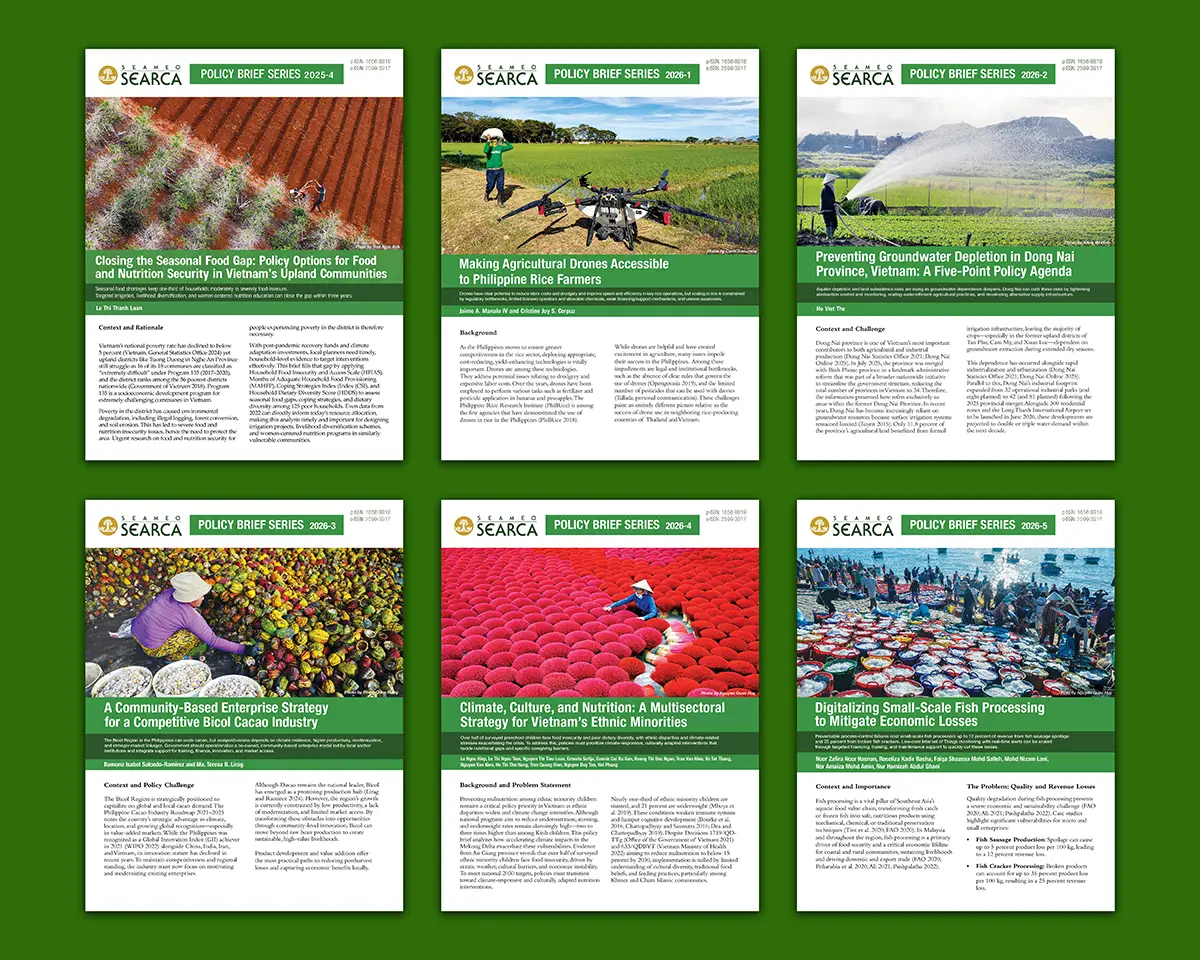
The collection includes insights into the Malaysian context, specifically through the brief "Digitalizing Small-Scale Fish Processing to Mitigate Economic Losses." This study demonstrates how Internet of Things (IoT) systems can help processors reduce spoilage and minimize revenue losses. The paper calls for government support through financing, training, and digital literacy programs to make these solutions accessible to small enterprises.
Shifting to the Philippines, the policy brief "Making Agricultural Drones Accessible to Philippine Rice Farmers" discusses how drones can boost efficiency and lower labor costs in rice production. It identifies barriers to adoption, such as expensive regulations, a lack of licensed operators, and inadequate financing. It recommends land consolidation, streamlined regulations, stronger public-private partnerships, and increased awareness campaigns to promote the responsible use of agricultural drones.
Moreover, "A Community-Based Enterprise Strategy for a Competitive Bicol Cacao Industry" outlines how the Philippine cacao sector can move beyond raw bean production through innovation and value addition. The study proposes a community-based enterprise (CBE) model to strengthen farmer organizations, improve market integration, and build partnerships that enhance competitiveness and local incomes.
In Vietnam, "Preventing Groundwater Depletion in Dong Nai Province, Vietnam: A Five-Point Policy Agenda," addresses the groundwater crisis driven by industrialization, urbanization, and water-intensive agriculture. It warns that unsustainable extraction threatens agricultural livelihoods and suggests measures such as improved monitoring, crop diversification, efficient irrigation, and community-based water governance to safeguard water security.
Meanwhile, "Climate, Culture, and Nutrition: A Multisectoral Strategy for Vietnam's Ethnic Minorities" examines how climate change, poverty, and cultural barriers lead to malnutrition among ethnic minority children in the Mekong Delta. It reveals severe food insecurity and dietary deficiencies in communities and advocates for culturally tailored nutrition programs, better healthcare access, and climate-resilient livelihoods. Complementing this is "Closing the Seasonal Food Gap: Policy Options for Food and Nutrition Security in Vietnam's Upland Communities," which investigates seasonal hunger and poor dietary diversity among vulnerable upland households in Nghe An Province. The study recommends expanding irrigation infrastructure, strengthening agricultural extension services, improving postharvest management, and diversifying livelihood opportunities to reduce food insecurity and improve nutrition outcomes.
The six policy briefs align with SEARCA's 4Ps framework, providing a roadmap for a resilient, inclusive, and innovation-driven agricultural sector in Southeast Asia. By addressing economic gains (Pocket), they explore how digital transformation—from drone technologies to IoT—and community-based enterprise models can reduce losses and boost local incomes.
To secure food and nutrition (Plate), the briefs advocate for climate-smart agriculture and nutrition-sensitive interventions that mitigate seasonal hunger and food insecurity.
Regarding environmental sustainability (Place), the briefs policies that emphasize water governance and climate-resilient livelihoods to protect regional ecosystems from mounting climate vulnerabilities.
At the heart of these efforts is a commitment to inclusivity and empowerment (People). The briefs prioritize vulnerable groups—including ethnic minorities, women caregivers, and rural entrepreneurs—ensuring that innovation translates into social gains.
Together, these publications reinforce SEARCA's commitment to advance evidence-based solutions. By bridging research and policy engagement, the Center continues to support Southeast Asia's transition toward sustainable, resilient, and inclusive agriculture.