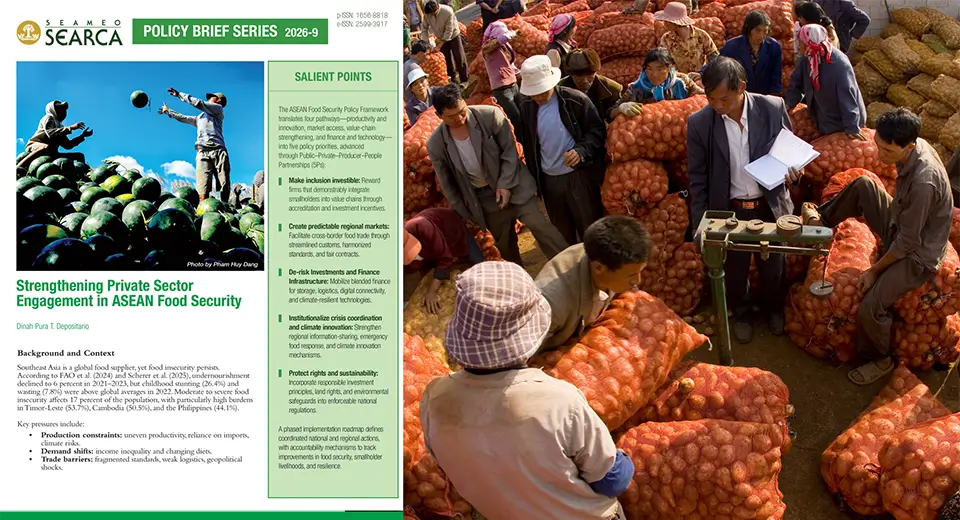
Southeast Asia is a major global food supplier, yet millions of people across the region still struggle to access affordable, nutritious food. A new policy brief published by the Southeast Asian Regional Center for Graduate Study and Research in Agriculture (SEARCA) calls for stronger private sector investment, innovation, and inclusive partnerships to help close this gap while improving smallholder livelihoods and strengthening regional food systems.
Titled "Strengthening Private Sector Engagement in ASEAN Food Security," the brief draws on the ASEAN Food Security Policy Framework developed by SEARCA in collaboration with the ASEAN Business Advisory Council (ASEAN-BAC) Philippines and the ASEAN Food Security Alliance (AFSA). Drawing on regional data, seven commodity assessments, case studies, and stakeholder consultations, the framework proposes practical ways to address persistent barriers to food security.
It identifies four interconnected pathways for private sector engagement: improving agricultural productivity and innovation, expanding smallholder market access, strengthening postharvest infrastructure and value chains, and mobilizing finance and technology for more resilient food systems.
To put these pathways into action, the framework sets out five policy priorities aimed at making smallholder inclusion attractive to investors, facilitating regional food trade, financing agricultural infrastructure, strengthening crisis coordination and climate innovation, and protecting land rights and environmental sustainability.
Key proposals include a USD 500 million–USD 1 billion ASEAN blended finance facility for agricultural infrastructure and innovation, and a Smallholder Inclusive Accreditation scheme that would reward businesses for demonstrably integrating smallholders into commercial value chains.
Central to the framework is the promotion of Public–Private–Producer–People Partnerships (5Ps), which enable governments, businesses, producer organizations, and communities to share investments, risks, decisions, and benefits. A phased implementation roadmap and accountability mechanisms would help translate these partnerships into measurable gains in farmer incomes, food access, and resilience.
SEARCA Center Director Dr. Mercedita Sombilla presented the framework at the ASEAN Food Security and Agribusiness Summit 2026, held in Manila on 10 October 2026. Organized by ASEAN-BAC Philippines, the summit advanced discussions on private sector participation and regional cooperation following earlier multistakeholder consultations.
Authored by Dr. Dinah Pura Depositario of the University of the Philippines Los Baños, the policy brief underscores a fundamental challenge for Southeast Asia: food security is not simply about producing more food, but about ensuring that farmers benefit from agricultural growth and that nutritious food becomes more accessible and affordable to all.