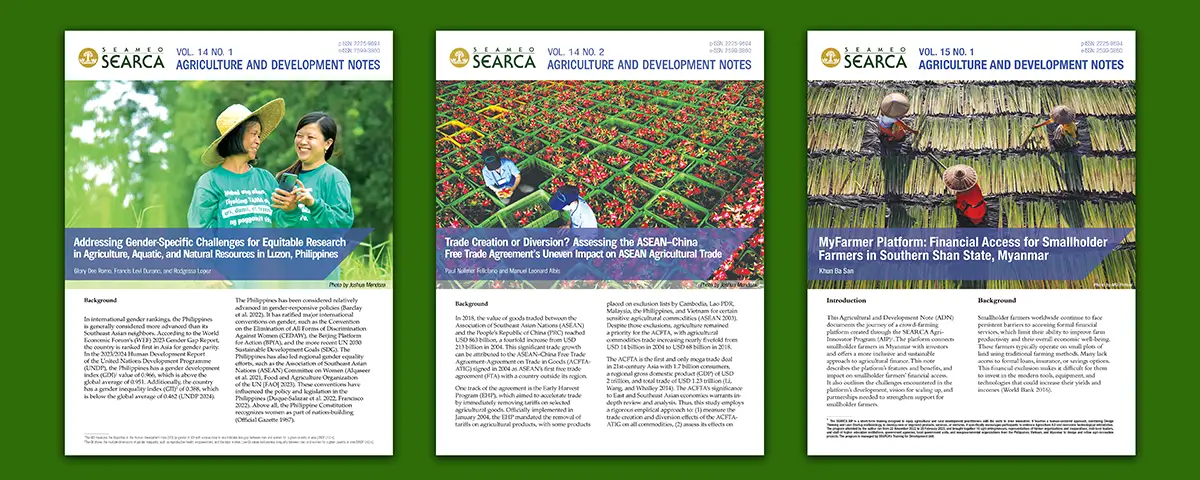
LOS BAÑOS, Philippines—The Southeast Asian Regional Center for Graduate Study and Research in Agriculture (SEARCA) has released three Agriculture and Development Notes (ADNs) aimed at advancing evidence-based agricultural and rural growth. By exploring gender equity in research, regional agricultural trade, and digital financial inclusion, the publications underscore the Center's commitment to addressing the region's multifaceted agricultural hurdles.
The new publications offer a distinct yet complementary perspectives on regional transformation. The new titles are "Addressing Gender-Specific Challenges for Equitable Research in Agriculture, Aquatic, and Natural Resources in Luzon, Philippines" by Glory Dee Romo, Francis Levi Durano, and Rodgessa Lopez; "Trade Creation or Diversion? Assessing the ASEAN–China Free Trade Agreement's Uneven Impact on ASEAN Agricultural Trade" by Paul Neilmer Feliciano and Manuel Leonard Albis; and "MyFarmer Platform: Financial Access for Smallholder Farmers in Southern Shan State, Myanmar" by Khun Ba San.
One of the ADNs examines the persistent gender-specific barriers faced by researchers within the Philippine agriculture, aquatic, and natural resources (AANR) sector. Despite the country's relatively high global gender parity rankings and existing gender-responsive laws, the study found that women researchers still face structural and institutional challenges in advancing gender-focused research.
Interviews with researchers from state universities and colleges in Luzon highlighted issues such as unequal access to opportunities, limited institutional support, challenges in balancing caregiving with research, and a lack of knowledge about gender-responsive methodologies. The authors called for stronger collaboration between research teams and Gender and Development (GAD) offices, alongside more inclusive funding, mentorship programs, and expanded capacity-building opportunities.
Shifting to regional commerce, another ADN explores the agricultural trade implications of the ASEAN–China Free Trade Agreement (ACFTA). Using an augmented gravity model and bilateral trade data, the study assessed whether the agreement generated trade-creation or trade-diversion effects between ASEAN economies and China.
The research found that while the ACFTA increased overall trade, its impact on agricultural trade varied widely among ASEAN members. Vietnam gained the most, while Cambodia, Lao PDR, and Brunei Darussalam faced significant challenges. The authors noted that free trade agreements drive agricultural growth only when supported by investments in infrastructure and technology.
Focusing on grassroots innovation, the third ADN highlights the MyFarmer platform in Myanmar. Developed through the SEARCA Agri-Innovator Program (AIP) with support from the SEARCA Grants for Research towards Agricultural Innovative Solutions (GRAINS), the digital crowd-farming platform connects smallholder farmers with investors to provide alternative financing mechanisms outside traditional banking systems.
Authored by Myanmar agri-preneur Khun Ba San, this publication outlines a platform inspired by the financial struggles of smallholder farmers in Shan State. It enables farmers to access capital for inputs and technologies while allowing investors to support and monitor agricultural projects directly. A pilot program in Southern Shan State improved access to quality inputs and reduced reliance on informal lenders. However, persistent gaps in digital literacy and connectivity underscore the need for human-centered design.
While tackling different issues, the publications share themes central to regional development.
A primary theme is inclusivity. Whether focusing on gender-sensitive research frameworks, fair participation in regional trade, or financial access for marginalized farmers, all three publications that agricultural advancement must support vulnerable and underserved populations. The ADNs all emphasize that policies and innovations should prioritize equity and accessibility alongside efficiency
The publications also highlight the role of institutions and capacity-building in driving meaningful change. The gender research note calls for stronger support systems and mentorship for researchers. The ACFTA publication emphasizes coordinated national agricultural strategies to maximize trade benefits, while the MyFarmer note focuses on farmer training and user-friendly technologies to enhance financial inclusion. Together, they demonstrate that sustainable agricultural development requires robust institutional support in addition to technology
The ADNs also underscore the necessity of evidence-based decision-making. Each ADN drew on empirical analysis and field experience to offer actionable recommendations for policymakers and practitioners. From gender-disaggregated data and trade analysis to digital farm-tracking systems, the studies highlight how reliable information can steer more effective and responsive interventions.