Development of the Coconut Industry Growth Areas in the Province of Quezon
Coconut production remains an important industry in the Philippines. Despite declines in overall share of global production and value over the years, the country remains the second top producer in the world next to Indonesia in 2017. It continues to employ a significant number of farmers as well as provide a primary source of income to many marginal rural households in Mindanao and the Southern Tagalog Region (IV-A).
Quezon is the top producer of coconut among provinces in the Philippines accounting for 10 percent of total supply nationwide and harvesting from around sixty percent (60%) of total agricultural land area in the province. However, like the majority of other cocal areas, numerous problems challenge growth and development in this predominantly monocropped sector. Among these are the ageing and low yield of many existing stands, limited use of technology and practice of diversification, low value-addition in production processes, and inadequate linkage to markets. These conditions combined contribute to the high poverty incidence in many coconut farming communities not only in Quezon but in other parts of the country as well.
A total of 2,151 stakeholders constitute Quezon province’s coconut industry. This includes smallholder farmers, traders and dealers of copra, nut, and lumber, as well as those involved in related food and non-food processing activities. Due to policy, organizational and institutional weaknesses, however, the integration and coordination of industry players in the system leaves much to be desired, leaving small farmers that constitute the majority in the sector heavily disadvantaged. Thus, the Provincial Government of Quezon (PGQ) embarked on an industry-wide investment plan to promote diversification and development of product value chains in key coconut areas of the province. With the Quezon’s Office of the Provincial Agriculturist (OPAg) at the forefront, various stakeholder groups in the coconut sector needs to be systematically organized - farmers, private sector, academe, R&D bodies and other support institutions - to develop a coconut industry roadmap that will serve as a catalyst for agri-industry development and socioeconomic growth. This effort will validate and further add flesh to the current coconut industry development planof the province through site-specific scoping, establishment of baseline, market scanning for commodity and product development, identification of resource opportunities and gaps, and mapping of local stakeholders for organizational and institutional development.
Organized around coconut and its derivatives as the banner product, the development of (or validation) coconut industry roadmap will enable intentional planning of site-suitable cropping pattern and the appropriate support package needed for product and value chain development as well as market demand analysis. Alongside this, OPAg and PCA, together with SEARCA, will spearhead the roll-out of technical assistance to promote learning events for technology development and adoption along the value chain, organizational leadership and entrepreneurship, partnership and collaboration, and knowledge production and dissemination.
While the roadmapping and related initiatives will be province-wide, the initial project area for the establishing the baseline study will be the Municipality of Catanauan to leverage on already existing infrastructure and project initiatives under its CocoQueST Project.
Information, Education, and Communication (ICE) Materials
Coco Sugar - A premium sweeterner from coconut blossom sap
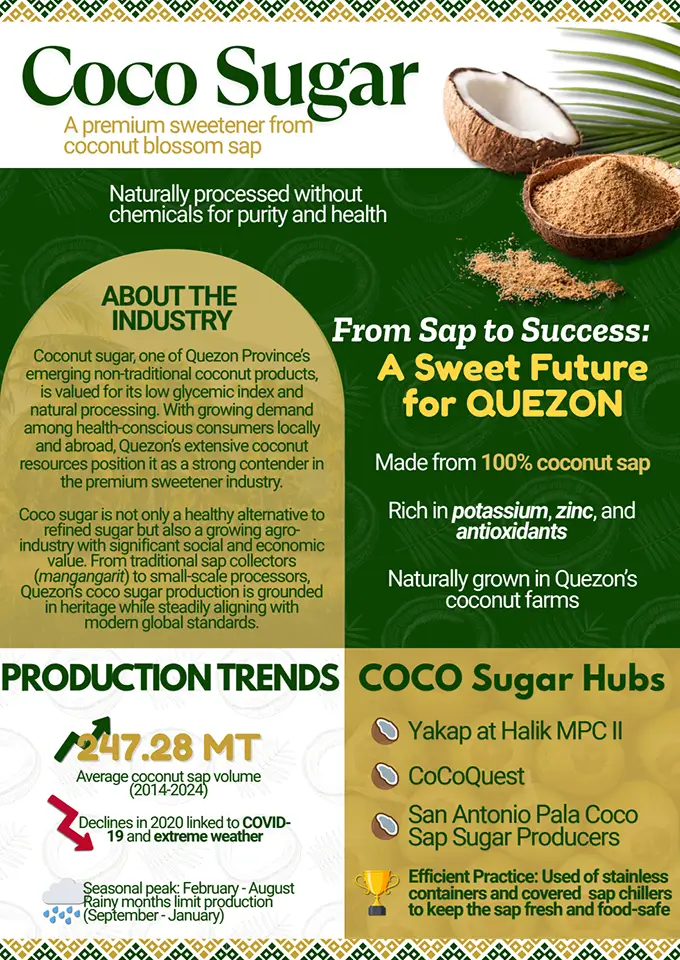 Coconut sugar, one of Quezon Province's emerging non-traditional coconut products, is valued for its low glycemic index and natural processing. With growing demand among health-conscious consumers locally and abroad, Quezon's extensive coconut resources position it as a strong contender in the premium sweetener industry.
Coco sugar is not only a healthy alternative to refined sugar but also a growing agroindustry with significant social and economic value. From traditional sap collectors (mangangarit) to small-scale processors, Quezon's coco sugar production is grounded in heritage while steadily aligning with modern global standards.
Copra - From coconut to commerce
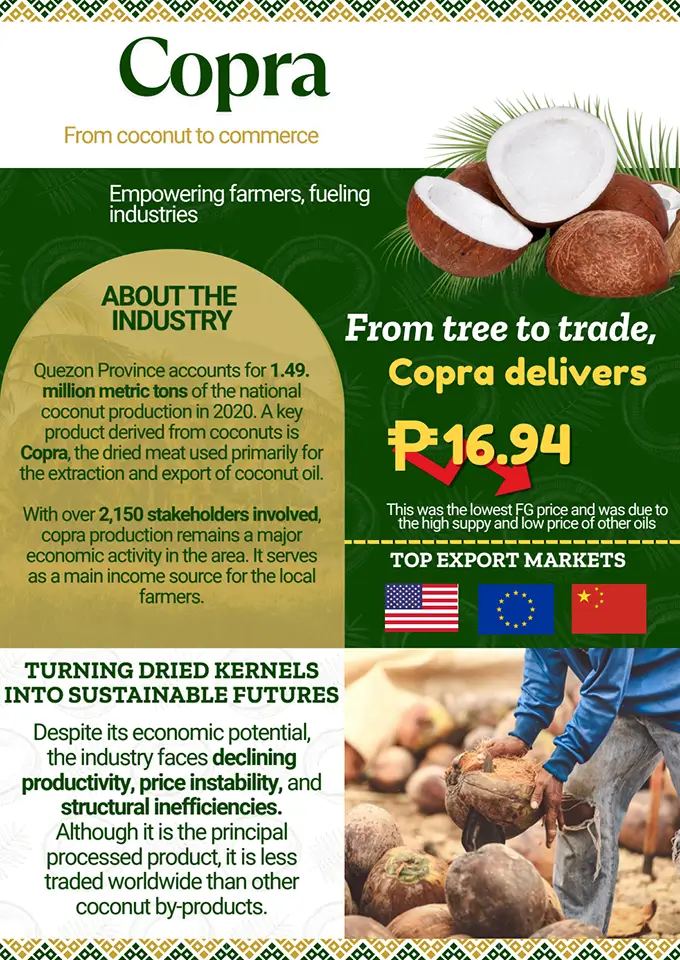 Quezon Province accounts for 1.49. million metric tons of the national coconut production in 2020. A key product derived from coconuts is Copra, the dried meat used primarily for the extraction and export of coconut oil.
With over 2,150 stakeholders involved, copra production remains a major economic activity in the area. It serves as a main income source for the local farmers.
Lambanog - From coconut to celebration
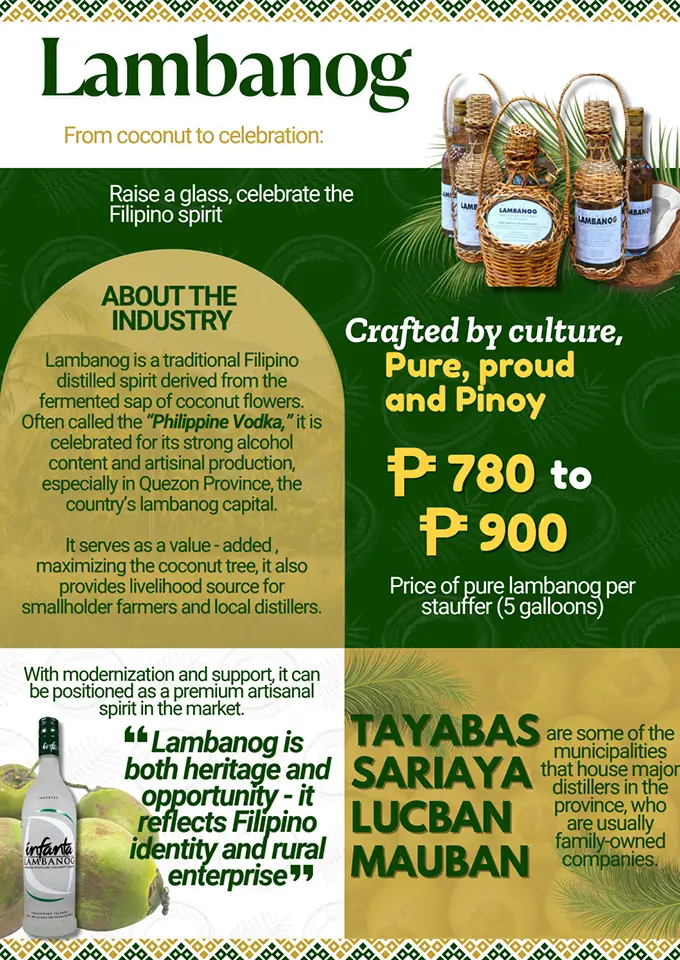 Lambanog is a traditional Filipino distilled spirit derived from the fermented sap of coconut flowers. Often called the "Philippine Vodka," it is celebrated for its strong alcohol content and artisinal production, especially in Quezon Province, the country's lambanog capital.
It serves as a value - added , maximizing the coconut tree, it also provides livelihood source for smallholder farmers and local distillers.
Virgin Coconut Oil - A premium product extracted from fresh, mature coconuts
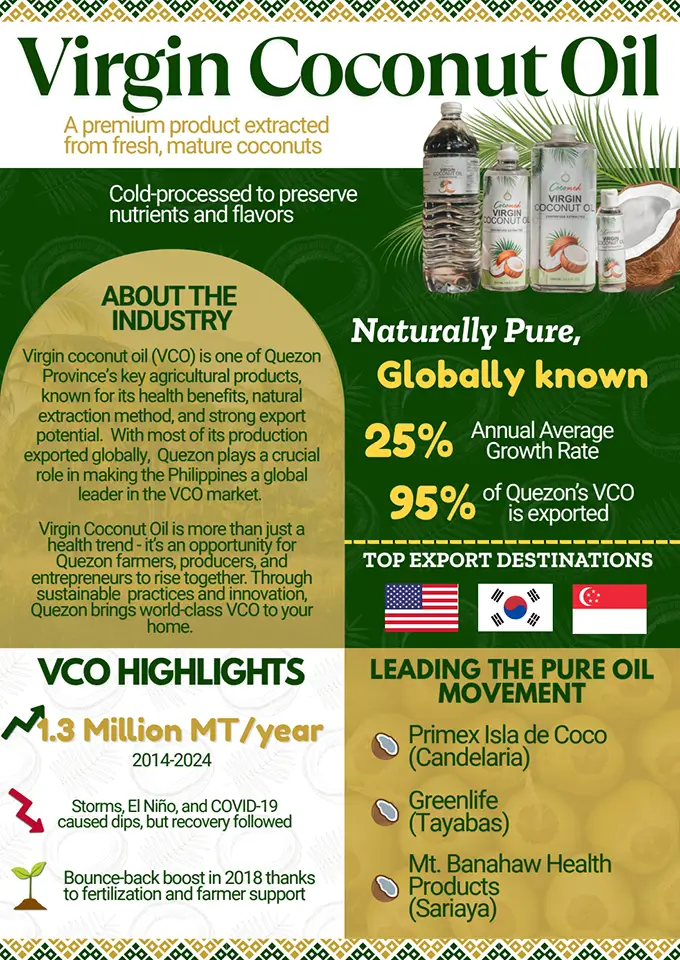 Virgin coconut oil (VCO) is one of Quezon Province’s key agricultural products, known for its health benefits, natural extraction method, and strong export potential. With most of its production exported globally, Quezon plays a crucial role in making the Philippines a global leader in the VCO market.
Virgin Coconut Oil is more than just a health trend - it’s an opportunity for Quezon farmers, producers, and entrepreneurs to rise together. Through sustainable practices and innovation, Quezon brings world-class VCO to your home.