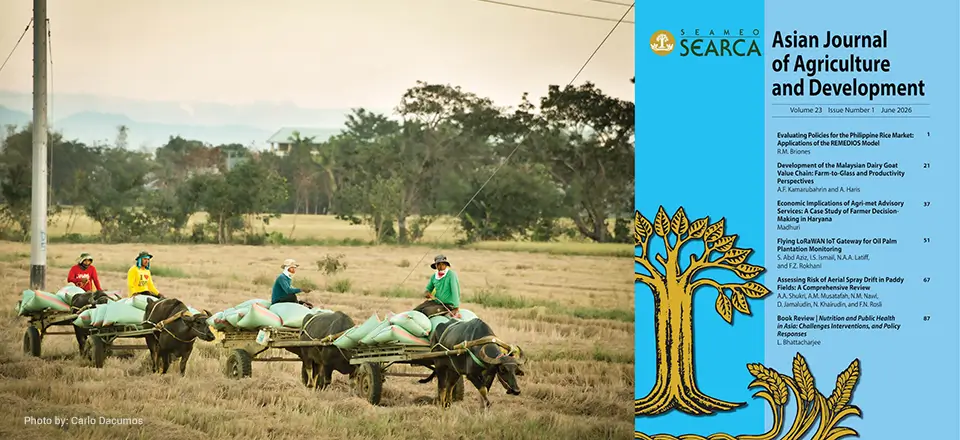
The June 2026 issue of the Asian Journal of Agriculture and Development (AJAD) highlights how stronger agri-food systems require more than higher production. Studies published in AJAD Volume 23 Number 1 examine how policy tools, value-chain coordination, digital infrastructure, advisory services, and risk-aware farm technologies can help improve agricultural outcomes across Asia.
The first paper in the issue, "Evaluating Policies for the Philippine Rice Market," introduces the Rapid Evaluation of Market Equilibrium with Differentiated Origin Sectors (REMEDIOS), a spreadsheet-based model that can quickly assess policies and help adjust them based on prevailing market conditions. Applying the model to the Philippine rice market, Filipino economist and rice policy expert Roehlano Briones of the Philippine Institute for Development Studies (PIDS) shows that despite its simplicity, REMEDIOS is "versatile enough to capture various market conditions and policies," including increased supply, lower world prices, higher tariffs, an import quota, and a floor price. The study emphasizes that REMEDIOS can help identify which policies benefit society, and by how much, by estimating losses and gains for producers, consumers, and the government. The Excel-based model may be accessed and downloaded for free at http://bit.ly/3YQpL9J.
"Development of the Malaysian Dairy Goat Value Chain" examines the Malaysian dairy goat industry through two analytical lenses: farm productivity and the "farm-to-glass" value chain. Aimi Fadzirul Kamarubahrin of Universiti Putra Malaysia (UPM) and co-author Asmaddy Haris of Universiti Sains Islam Malaysia reviewed earlier studies on the industry, noting that the productivity lens focuses on resource-use efficiency, whereas the farm-to-glass approach highlights gaps in processing, distribution, and retail linkages. Their findings show that although Malaysia has strong potential for dairy goat expansion, the industry remains constrained by fragmented value chains, limited infrastructure, and uneven productivity. The study points to the need to strengthen production, processing, and market linkages to support a more sustainable and resilient dairy goat sector.
Three other articles in the issue focus on digital farming tools and risk management in India and Malaysia. "Economic Implications of Agri-met Advisory Services" investigates how agrometeorological advisory services influence farmers' production decisions and economic outcomes in Haryana, India. The findings of Madhuri of Symbiosis International Deemed University indicate that timely weather-based information helps farmers make better management decisions, contributing to improved productivity, reduced risks, and higher farm profitability.
Meanwhile, "Flying LoRaWAN IoT Gateway for Oil Palm Plantation Monitoring" presents a drone-mounted LoRaWAN Internet of Things (IoT) gateway designed to improve communication with sensors deployed across oil palm plantations. Samsuzana Abd Aziz and co-authors from UPM and Universiti Malaysia Terengganu propose a system that enhances data collection in areas with limited network coverage, demonstrating the potential of integrating unmanned aerial vehicles and IoT technologies for smarter plantation management.
Another article, "Assessing Risk of Aerial Spray Drift in Paddy Fields," synthesizes current knowledge on the weather, equipment, and operational factors that influence aerial spray drift in paddy fields. Written by Azmeer Ahmad Shukri and co-authors from UPM, the review discusses strategies and emerging technologies that can minimize spray drift and improve the safety, efficiency, and environmental sustainability of pesticide application.
The issue also includes a book review by retired Food and Agriculture Organization of the United Nations (FAO) senior nutritionist Lalita Bhattacharjee. Her review of Nutrition and Public Health in Asia: Challenges, Interventions, and Policy Responses discusses the book's treatment of Asia's nutrition and public health challenges, ranging from undernutrition and micronutrient deficiencies to the growing burden of obesity and diet-related noncommunicable diseases. The review also notes the book's emphasis on evidence-based interventions and policy responses that can help countries strengthen food systems and improve population nutrition and health outcomes.
The latest AJAD articles and previous journal issues may be downloaded for free from ajad.searca.org. Print copies are also available by subscription or on request from the publisher, the Southeast Asian Regional Center for Graduate Study and Research in Agriculture (SEARCA).
AJAD is SEARCA's official international scientific journal. It publishes empirical, policy-oriented, and institutional development studies, as well as perspective articles on agriculture and development, the political economy of rural development, and trade issues. Submissions are welcome year-round through https://ajad.searca.org/submit
The AJAD editorial board is chaired by Dr. Cielito Habito, former Socioeconomic Planning Secretary and Director General of the National Economic and Development Authority of the Philippines. He also served as professor of economics at the Ateneo de Manila University and director of the Ateneo Center for Economic Research and Development.