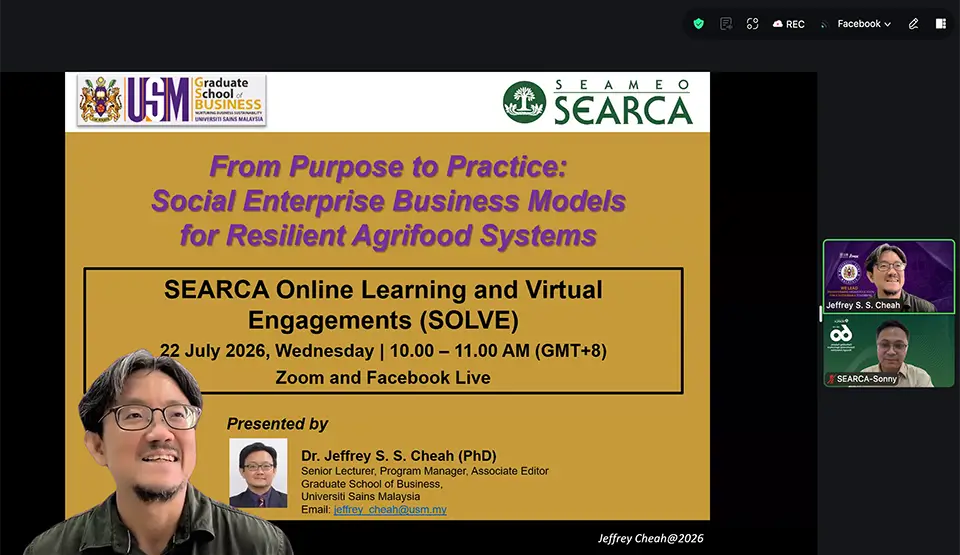
Social enterprises play an important role in strengthening resilient and inclusive agrifood systems by addressing market inefficiencies while creating lasting social and economic impact, a social entrepreneurship expert said during the 56th installment of the Southeast Asian Regional Center for Graduate Study and Research in Agriculture (SEARCA) Online Learning and Virtual Engagement (SOLVE) webinar series held on 22 July 2026.
Speaking to more than 200 participants on Zoom and Facebook Live, Dr. Jeffrey Cheah, Senior Lecturer and Online MBA Program Manager at the Graduate School of Business, Universiti Sains Malaysia, underscored how social enterprise business models can respond to persistent challenges faced by smallholder farmers, including climate risks, fragmented value chains, limited access to markets, and low bargaining power.
In his presentation "From Purpose to Practice: Social Enterprise Business Models for Resilient Agri-Food Systems," Cheah emphasized that social enterprises are uniquely positioned to generate both economic and social value by combining commercial viability with a clear social or environmental mission.
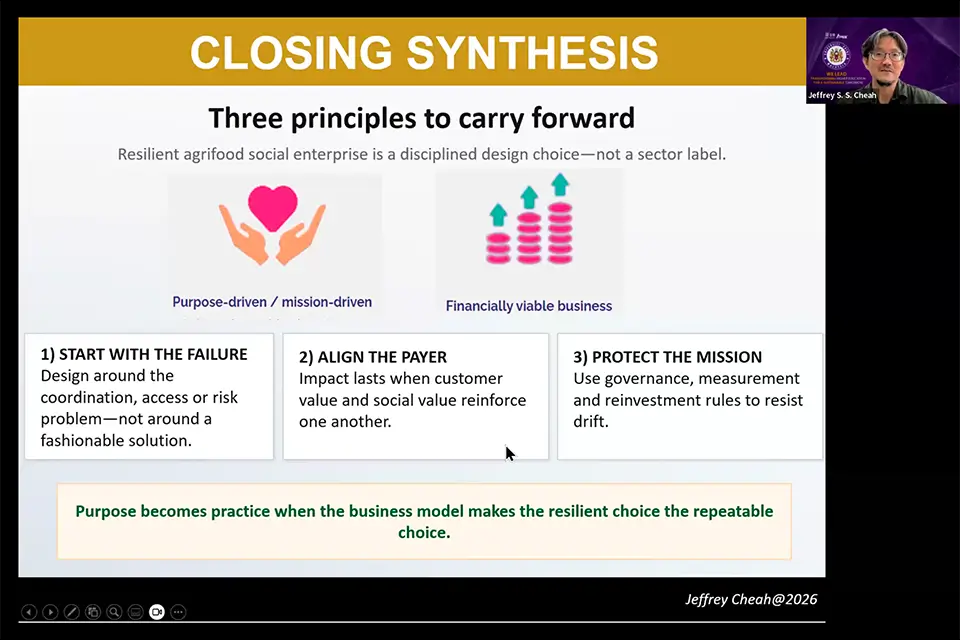
"Social entrepreneurship allows us to redesign who creates value, who pays, and who shares the gains," Cheah said, highlighting how innovative business models can create more equitable outcomes across agricultural value chains.
He explained that, unlike traditional businesses that prioritize profit maximization or charities that rely primarily on grants and donations, social enterprises sustain their operations through commercial activities while reinvesting a substantial share of their earnings to advance their social mission. This hybrid approach enables organizations to remain financially viable while addressing social and environmental challenges.
To demonstrate these principles in practice, Cheah showcased several social enterprise initiatives from across the region. These included Langit Collective, which connects Malaysian indigenous farmers with urban consumers to preserve native rice varieties and improve farmer livelihoods; Mayani in the Philippines, a digital marketplace that links smallholder farmers directly with consumers and institutional buyers; and Coffee for Peace, which supports conflict-affected coffee-farming communities through farmer training, quality improvement, and expanded market access. He also cited initiatives from Lao PDR, Thailand, and Singapore.
Despite operating in different contexts, Cheah noted that these enterprises share common strategies: aggregating demand, strengthening producers' capacities, improving market access, and distributing risks more equitably across agricultural value chains. "The enterprise earns its place by solving coordination failures, not by adding a mission statement to ordinary trade," he added.
The webinar also highlighted the growing role of higher education institutions (HEIs) in developing the next generation of social entrepreneurs. During the open forum, Cheah also encouraged students and young professionals to start small, learn through experimentation, and view entrepreneurship as a viable career path for generating meaningful impact across the agriculture sector.
The SOLVE webinar series is SEARCA's flagship online knowledge-sharing platform for convening experts, practitioners, researchers, policymakers, and development partners to discuss emerging issues, innovative approaches, and practical solutions for transforming agrifood systems across Southeast Asia.