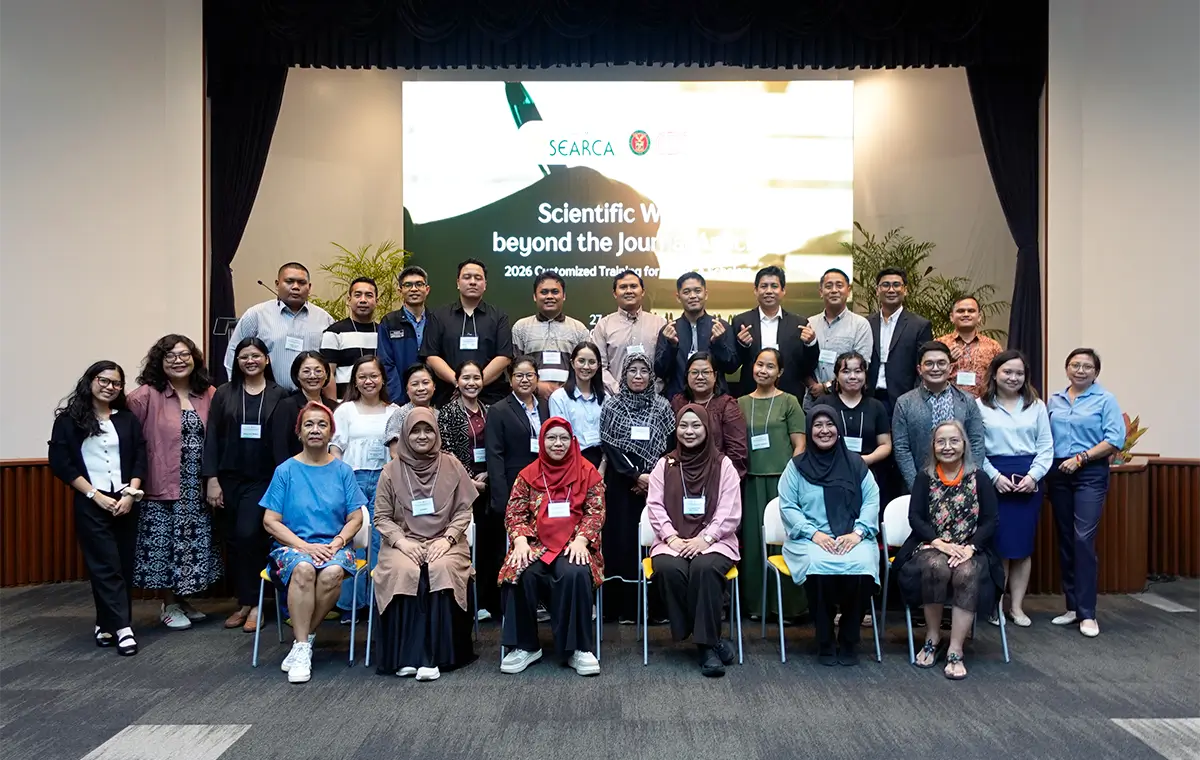
 Twenty-six SEARCA scholars from six Southeast Asian countries completed the five-day 'Beyond the Journal Article' training on 27–31 July 2026 at SEARCA
LOS BAÑOS, Philippines—Twenty-six scholars of the Southeast Asian Regional Center for Graduate Study and Research in Agriculture (SEARCA) from Cambodia, Indonesia, Malaysia, Myanmar, the Philippines, and Vietnam completed the five-day customized training on "Beyond the Journal Article: Scientific Writing for Policy and Wider Scholarly Engagement," held on 27-31 July 2026 at SEARCA. The training equipped master's and PhD scholars with practical skills for transforming their thesis or dissertation research into publication plans, policy briefs, and book chapter proposals, thereby broadening the reach and impact of their research.
Held under the Center's Graduate-on-Time (GOT) Program, the training was organized in partnership with the University of the Philippines Los Baños (UPLB) College of Development Communication (CDC).
In her opening message, Dr. Maria Cristeta Cuaresma, Senior Program Head of SEARCA's Education and Collective Learning Department (ECLD), emphasized the broader purpose of GOT customized trainings: "We do not want to simply build your individual capacities, but rather invest in you so that when you go back to your countries and communities, you could be ambassadors of SEARCA working for sustainable agricultural transformation."
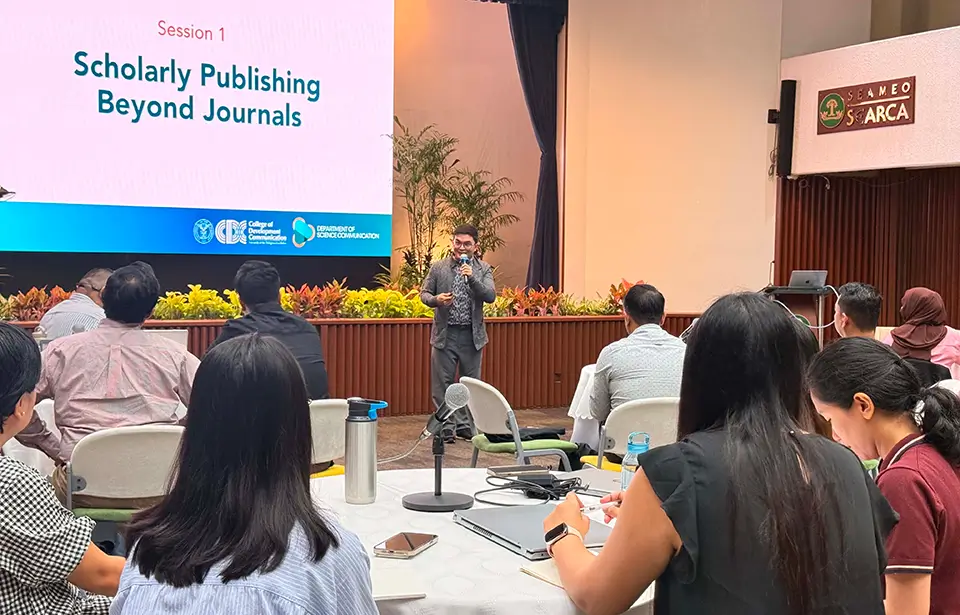 Assoc. Prof. Dr. Winifredo Dagli of the UPLB College of Development Communication served as Technical Coordinator of the program.
The training reframed scholarly publication as both an academic responsibility and a means of contributing to social change. Assoc. Prof. Dr. Winifredo Dagli of the UPLB CDC Department of Science Communication emphasized that while journal articles remain essential, they may not always be the most appropriate format for communicating research findings to policymakers, practitioners, communities, and the wider public.
Participants learned to match research evidence with the needs of specific audiences and purposes. In the policy communication sessions, they practiced identifying communication objectives and target audiences, presenting key messages in plain language, and connecting urgent problems with relevant evidence, feasible options, and clear recommendations. They also learned to narrow broad research questions, develop a focused arguments, build claim-evidence-reasoning chains, and revise their writing for logic, clarity, and accuracy.
Sessions on books and other publication avenues emphasized that transforming a dissertation into another publication format requires reconceptualization rather than simply repackaging. Scholars learned to develop a narrative arc, reduce jargon and extensive literature reviews, and ensure that each chapter contributes to the book's overall purpose. The training also covered how to select suitable publication outlets, avoiding predatory publishers, navigating peer review and rejection, and upholding research and publication ethics. The responsible use of AI was discussed as a tool for limited tasks, such as outlining and revising, while emphasizing that AI-assisted outputs must be verified and, when required, documented and disclosed.
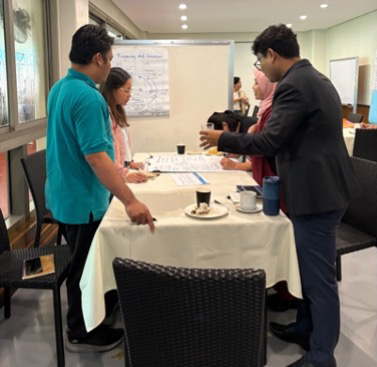
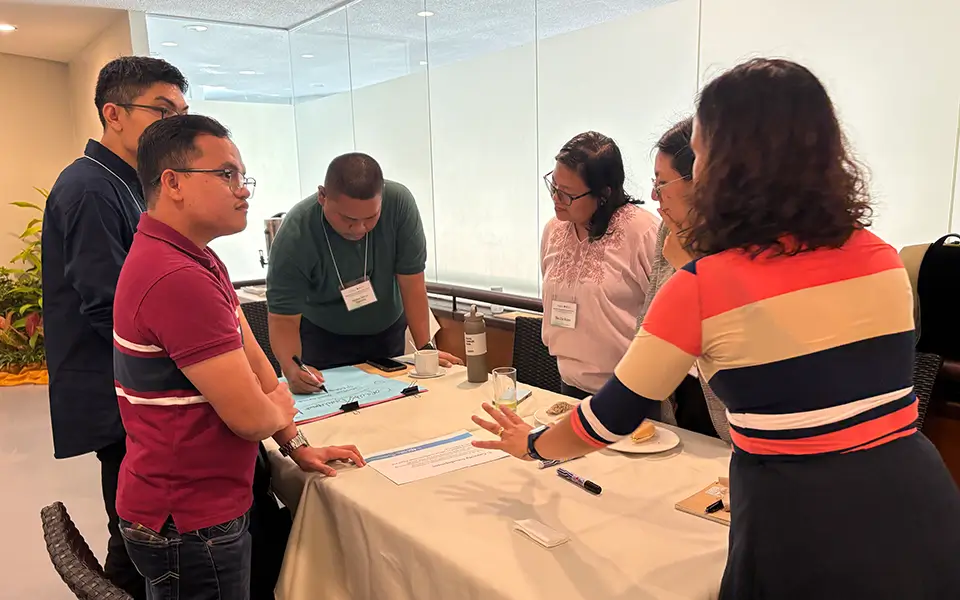
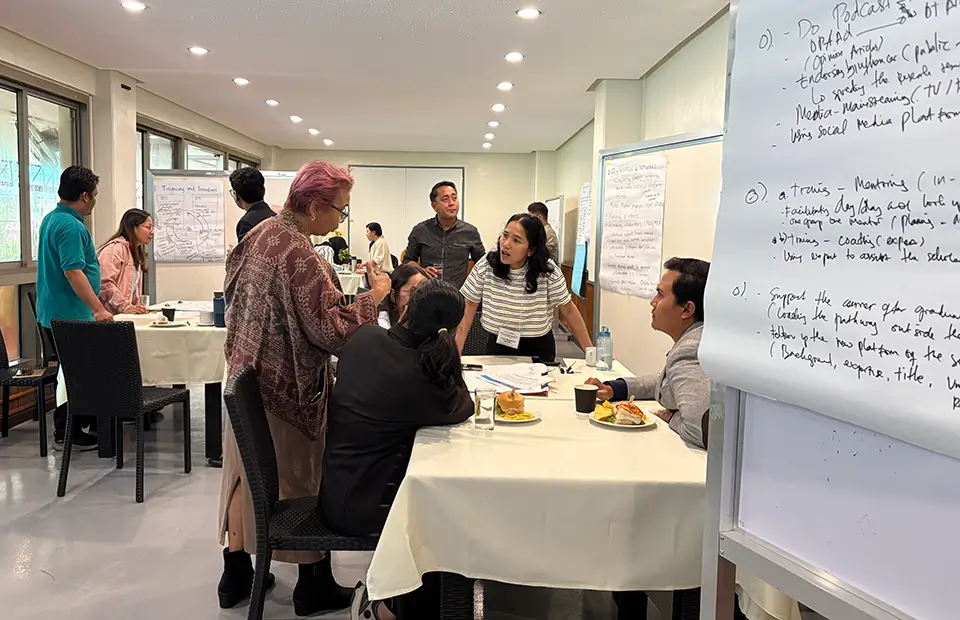
Through the World Café, scholars engaged in participatory dialogue and knowledge sharing.
The training concluded with a World Café session in which scholars proposed ways to strengthen capacity development, collaboration and networks, financing and incentives, institutional support, and the continuation of research beyond graduate education. They also explored how SEARCA, their home institutions, alumni networks, publishers, and other partners could help sustain their research, writing, and publication momentum beyond their degree programs.
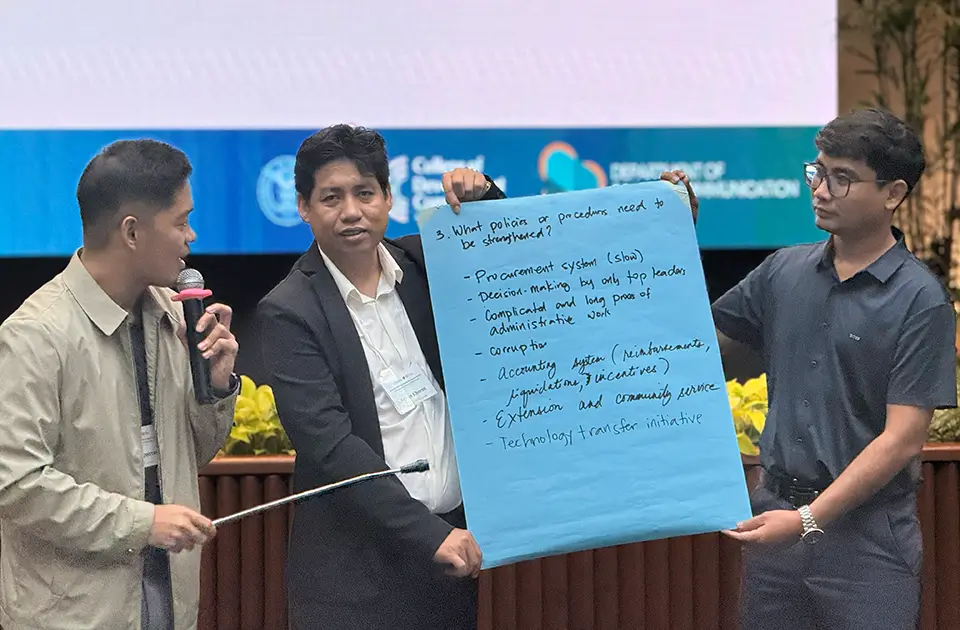
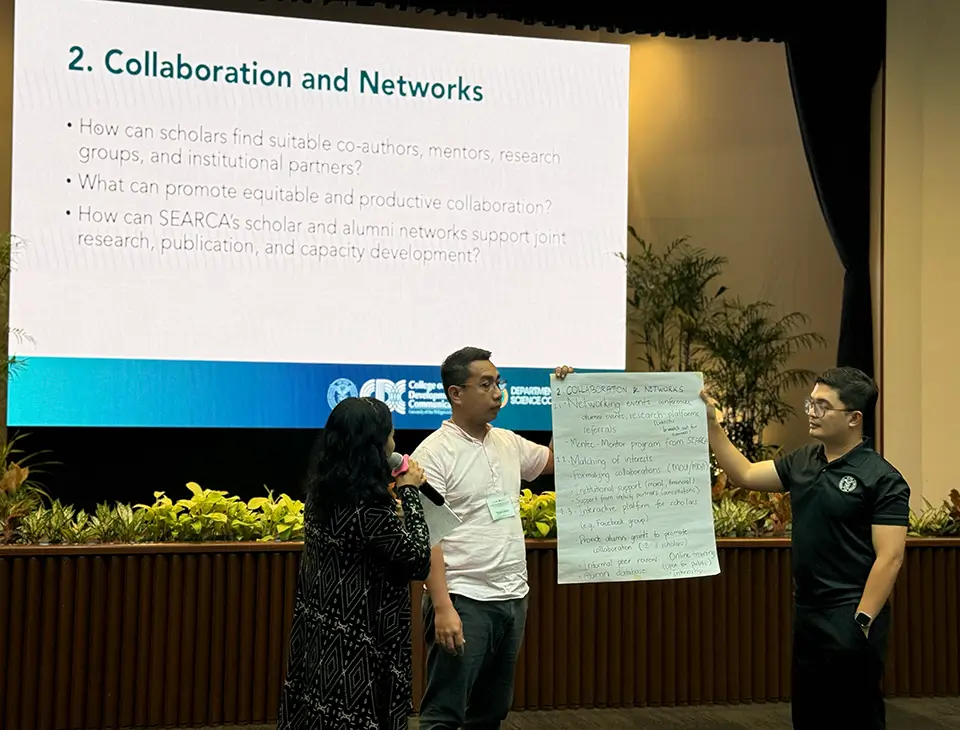
At the close of the training, the scholars presented key insights and recommendations from the five-day program.
By strengthening scholars' capacity to translate research into accessible, actionable knowledge tailored to different audiences, the training contributes to SEARCA's 12th Five-Year Development Plan, focused on Sustainable Transformation of Agricultural Systems through Innovation in Southeast Asia (SUSTAIN Southeast Asia). It also reinforces the GOT Program's aim of developing researchers and development leaders who can move research evidence beyond academe and into knowledge, policy, and practice across the region.