LOS BAÑOS, Philippines—The Southeast Asian Regional Center for Graduate Study and Research in Agriculture (SEARCA) has released Vietnamese translations of two policy briefs that address pressing agricultural and rural development challenges in Vietnam. The translated briefs aim to make evidence-based policy recommendations more accessible to Vietnamese policymakers, researchers, local planners, extension workers, and development practitioners working on food and nutrition security, water resources management, and climate-resilient agriculture.
The two translated publications are "Closing the Seasonal Food Gap: Policy Options for Food and Nutrition Security in Vietnam's Upland Communities" by Le Thi Thanh Loan and "Preventing Groundwater Depletion in Dong Nai Province, Vietnam: A Five-Point Policy Agenda" by Ho Viet The.
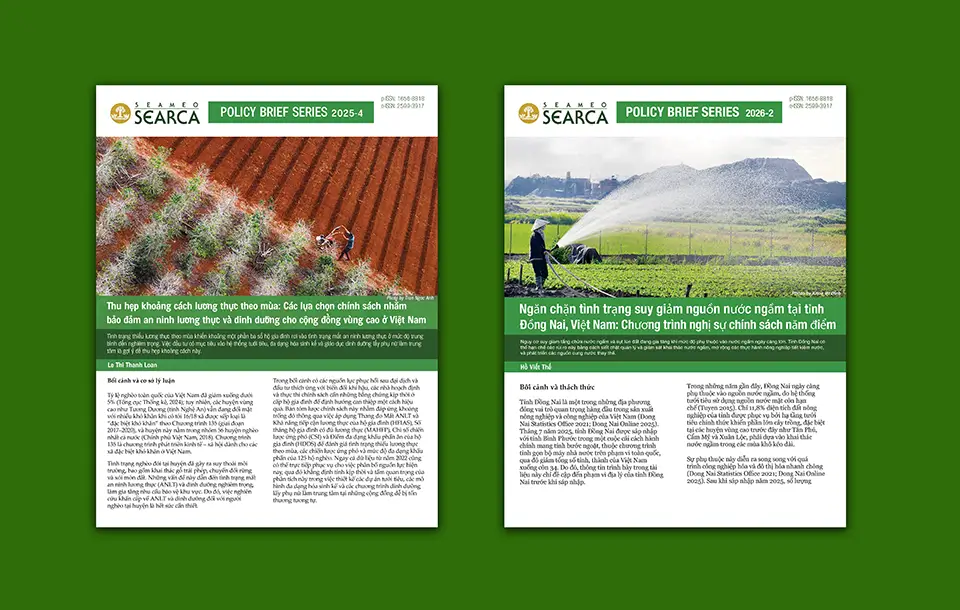
The first policy brief examines food and nutrition insecurity among poor households in Tuong Duong District, Nghe An Province, where upland communities continue to face seasonal food shortages despite Vietnam's broader progress in reducing poverty. It recommends scaling up agricultural production and irrigation, strengthening agricultural training and extension, improving postharvest management, diversifying livelihoods and income sources, enhancing nutrition programs, with particular attention to women decision-makers, and improving roads and market access in underserved communes.
The second policy brief highlights the risks of groundwater depletion in Dong Nai Province, a key agricultural and industrial area in Vietnam. It addresses concerns such as aquifer stress, declining groundwater quality, limited crop resilience to water scarcity, enforcement gaps, lack of real-time abstraction data, and farmers' insufficient access to knowledge, financing, and irrigation alternatives. To address these risks, the brief proposes a five-point policy agenda: strengthen regulation and monitoring, promote crop diversification and efficient water use, empower farmers through training and finance, develop alternative water sources, and enhance institutional coordination and community engagement.
While the two publications address different development concerns, they share common themes that are central to Vietnam's agricultural transformation. Both emphasize that vulnerable farming communities need targeted, evidence-based support to withstand seasonal, environmental, and economic pressures. The food security brief focuses on poor upland households facing hunger, limited dietary diversity, and weak market access. In contrast, the groundwater brief focuses on farmers and communities threatened by water scarcity, declining aquifer quality, and mounting competition for water resources. Together, they underscore the importance of climate-smart agriculture, stronger local institutions, improved infrastructure, farmer training, inclusive financing, and coordinated public action.
Both briefs also point to the close relationship between natural resource management and rural livelihoods. Food security in upland communities depends not only on household income and nutrition knowledge but also on irrigation, roads, agricultural extension, and resilient production systems. Likewise, groundwater sustainability in Dong Nai depends not only on regulation but also on crop choices, farmer capacity, alternative water infrastructure, and community participation.
By translating these policy briefs into Vietnam's national language, SEARCA seeks to support wider knowledge sharing and help Vietnamese stakeholders apply practical policy options that strengthen resilience, sustainability, and inclusive agricultural development in the country.