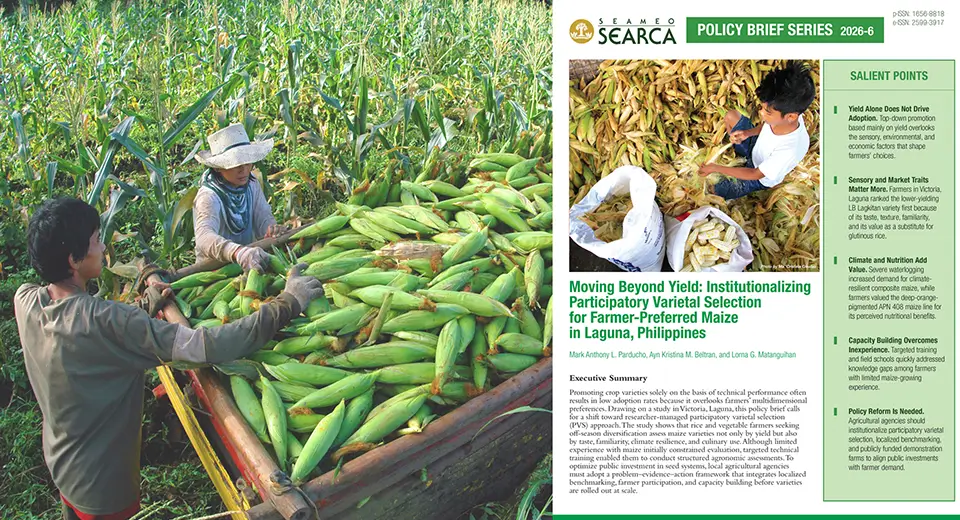
LOS BAÑOS, Philippines—Research supported by the Southeast Asian Regional Center for Graduate Study and Research in Agriculture (SEARCA) is showing why farmers need a stronger voice in deciding which crop varieties move from experimental fields into their farms and markets.
Findings from a study led by Mr. Mark Anthony Parducho, a recipient of the SEARCA Seed Fund for Research and Training (SFRT), form the basis of a new SEARCA policy brief calling for agricultural agencies to look beyond yield when selecting and promoting maize varieties.
Titled "Moving Beyond Yield: Institutionalizing Participatory Varietal Selection for Farmer-Preferred Maize in Laguna, Philippines," publication draws on research in Victoria, Laguna, where rice and vegetable farmers exploring maize for off-season diversification assessed varieties not only for yield but also for taste, familiarity, climate resilience, culinary use, and other characteristics important to their households and livelihoods.
The policy brief was authored by Parducho, Ms. Ayn Kristina Beltran, and Ms. Lorna Matanguihan of the Institute of Plant Breeding, College of Agriculture and Food Science, University of the Philippines Los Baños.
From seed funding to policy action
Parducho's research exemplifies the purpose behind SEARCA's SFRT, which is to provide catalytic start-up support for Southeast Asian researchers and scientists whose promising research and training initiatives may otherwise be constrained by limited early-stage funding.
SEARCA designed the fund to do more than finance individual studies. SFRT seeks to strengthen researchers' capacity to develop proposals and manage projects, expand the regional knowledge base for agricultural and rural development, and help promising initiatives build toward longer-term support. Current SFRT-supported proposals are also expected to contribute strategically to increased farmers' incomes, improved food security and nutrition, greater climate resilience, or the empowerment of farmers and agricultural stakeholders.
The program deliberately connects research with its eventual use. SFRT projects are expected to include strategies for communicating results and policy recommendations, while required outputs include a policy brief and a research report suitable for technical publication.
The policy brief arising from Parducho's research illustrates that pathway from relatively small, targeted research support to evidence that can inform agricultural programs and policy. In this case, field-level observations about what farmers actually value in maize varieties have been translated into recommendations for varietal selection, extension, local benchmarking, and public investment.
Farmers look beyond maize yield
The Victoria study challenges a largely yield-centered approach to crop promotion by showing that technical performance alone does not necessarily determine whether farmers prefer a variety.
In researcher-managed participatory varietal selection (PVS) trials, farmers evaluated six maize lines using an integrated selection index covering yield, sensory traits, milling recovery, and storability. The results showed that farmers weighed how well a variety fitted household needs, food preferences, production conditions, and potential uses alongside its agronomic performance.
One of the clearest examples was LB Lagkitan, a lower-yielding glutinous maize variety that farmers ranked as their top choice because of its taste, texture, cultural familiarity, and value as a substitute for relatively costly glutinous rice in local delicacies.
The finding is significant for agricultural development because it illustrates a central challenge in technology adoption. A variety that performs well according to technical measures may still fail to gain traction if it does not meet the priorities of the people expected to grow, consume, or sell it.
Climate resilience also shaped farmers' choices. Intense rainfall and prolonged waterlogging during the trials required repeated crop re-establishment. Farmers consistently ranked a waterlogging-tolerant composite maize second, indicating the importance of production stability when growing conditions become difficult.
Farmers also favored APN 408, a deep-orange-pigmented maize line. They associated its color with nutritional benefits and recognized possibilities for value-added niche products.
Together, these findings demonstrate why participatory varietal selection can complement conventional crop evaluation: it brings into the decision-making process the sensory, environmental, livelihood, and market considerations that farmers encounter in actual production settings.
Training enables informed farmer choice
The study also underscores the importance of agricultural extension and capacity development when farmers are introduced to unfamiliar crops.
Because participating farmers were primarily accustomed to rice production, their initial experience in maize management was limited. Targeted technical training, lectures, and field monitoring, however, improved their ability to assess agronomic and field-management performance.
This has an important implication for crop diversification programs. Limited farmer experience with an alternative crop need not be treated as a fixed barrier to adoption. When varietal promotion is paired with appropriate technical support, farmers can develop the knowledge needed to evaluate new options and make more informed production decisions.
For rice-reliant communities such as Victoria, diversification has become increasingly important amid erratic rainfall and waterlogging. The brief cautions, however, that introducing alternative crops without sufficient attention to local socioeconomic conditions can result in poor market fit and weak adoption. Participatory selection can help align varieties with farmer preferences, climate risks, and market demand.
Three policy actions for farmer-centered varietal selection
Building on the research findings, the authors recommend three measures for incorporating participatory varietal selection more systematically into agricultural extension and crop development.
First, municipal agricultural offices and regional research centers should institutionalize PVS before recommending or distributing new crop varieties. Evaluation should consider not only yield but also local sensory preferences, culinary uses, and market demand.
Second, local government units, state universities, and agricultural agencies should undertake localized benchmarking before rollout. Municipal-level assessments of soil suitability, climate risks, farmer capacity, and market demand could help ensure that public resources are directed toward crop varieties suited to local conditions.
Third, the brief recommends investing in capacity building and municipal demonstration farms to provide hands-on learning, strengthen farmer confidence, and generate further evidence on adoption, socioeconomic effects, and nutritional outcomes.
Turning research into development outcomes
The authors conclude that crop diversification is unlikely to succeed through top-down, yield-focused approaches alone. Farmers also consider sensory quality, climate resilience, and local marketability, while direct participation and training can strengthen their ability and confidence to evaluate unfamiliar crops.
For SEARCA, the progression of Parducho's SFRT-supported work from field research to a policy brief also demonstrates the strategic value of seed funding as an investment in the research-to-policy continuum. By enabling researchers to test promising ideas, generate locally grounded evidence, build research capacity, and translate findings into actionable recommendations, SFRT can help move agricultural research beyond academic output toward wider development use. This reflects the program's stated aim of turning promising research and training into scientific outputs that can contribute to agricultural development while positioning worthy initiatives for sustained support.
In the case of farmer-preferred maize, that pathway has produced a straightforward policy message that better varietal decisions begin not only with what performs well in the field, but also with what farmers are willing and able to grow, use, and bring to market.