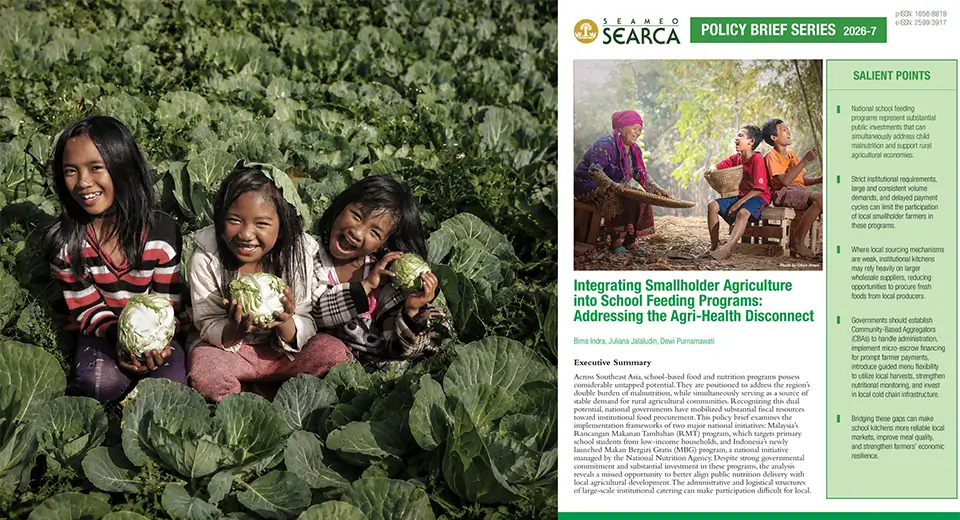
LOS BAÑOS, Philippines—School feeding programs in Southeast Asia could do more than improve children's nutrition. With procurement systems designed to include local producers, these major public investments could also create more reliable markets for smallholder farmers and strengthen rural economies, according to a new policy brief published by the Southeast Asian Regional Center for Graduate Study and Research in Agriculture (SEARCA).
The SEARCA policy brief, titled "Integrating Smallholder Agriculture into School Feeding Programs: Addressing the Agri-Health Disconnect," examines how school feeding programs can better connect public nutrition spending with local agricultural development.
The brief grew out of cross-border research undertaken by Dr. Bima Indra, a medical doctor pursuing Master of Public Health at Universitas Muhammadiyah Jakarta, together with her supervisors Dr. Juliana Jalaludin at Universiti Putra Malaysia and Dr. Dewi Purnamawati at Universitas Muhammadiyah Jakarta. Conducted in Malaysia and Indonesia from April to May 2026, the research was supported by SEARCA through its Student Mobility Grant.
The work illustrates the wider purpose of SEARCA's support for academic mobility. The Center's Faculty and Student Mobility Grant enables grantees to undertake research or credit-bearing study at University Consortium member universities and other prominent agricultural universities or research institutions, while gaining exposure to new technologies and training from leading academics and researchers. In this case, mobility enabled research across two Southeast Asian settings and helped translate that comparative learning into policy recommendations on the intersection of agriculture, nutrition, and public procurement.
The policy brief examines Malaysia's Rancangan Makanan Tambahan (RMT), which targets primary school pupils from low-income households, and Indonesia's Makan Bergizi Gratis (MBG), a national initiative managed by the National Nutrition Agency.
School feeding as a market for smallholder farmers
The authors argue that school feeding represents an important but still underused opportunity to address two development challenges at once: persistent malnutrition among children and limited access to stable markets among rural agricultural communities.
Across Southeast Asia, substantial public resources are being directed toward institutional food procurement. That spending creates large and relatively stable demand for food, which could generate opportunities for local farmers if procurement systems are structured to enable their participation.
The policy question, therefore, extends beyond what children are served. It also concerns where the food comes from, who is able to supply it, and how public spending can create value within local food systems.
Why smallholders struggle to supply school feeding programs
The policy brief identifies what it describes as an "agri-health disconnect" between the requirements of institutional food procurement and the realities facing many smallholder farmers.
School kitchens serving hundreds of children need reliable quantities of food, formal invoices, compliance with food safety requirements, and suppliers able to operate under government reimbursement arrangements. In the cases examined, payment cycles can extend from 30 to 60 days.
Smallholder farmers, meanwhile, may individually produce too little of a particular crop to meet an institution's daily requirements. Some operate informally, lack the administrative capacity to issue electronic invoices, or do not hold certifications required by institutional buyers. Many also need to be paid soon after harvest to finance seeds, fertilizer, and other inputs for the next production cycle.
This mismatch in scale, administration, and liquidity can make direct farmer-to-school transactions difficult. Institutional kitchens may consequently turn to larger wholesale suppliers that can handle bulk deliveries, formal requirements, and delayed payment.
The findings are based on an exploratory qualitative case study conducted in selected sites in Malaysia and Indonesia. The researchers combined expert consultations and reviews of national technical guidelines with operational walkthroughs and interviews involving actors responsible for procurement and daily menu implementation.
At the local level, operators expressed interest in sourcing food locally but identified limited liquidity and concerns over audit compliance as important barriers. The study also found that budget, logistical, and procurement constraints can affect the types of food used to meet nutritional requirements.
Aggregating smallholder supply
Among the brief's principal recommendations is the establishment of Community-Based Aggregators (CBAs) that could bring together produce from multiple smallholder farmers while handling institutional requirements such as invoicing, tax compliance, and certification.
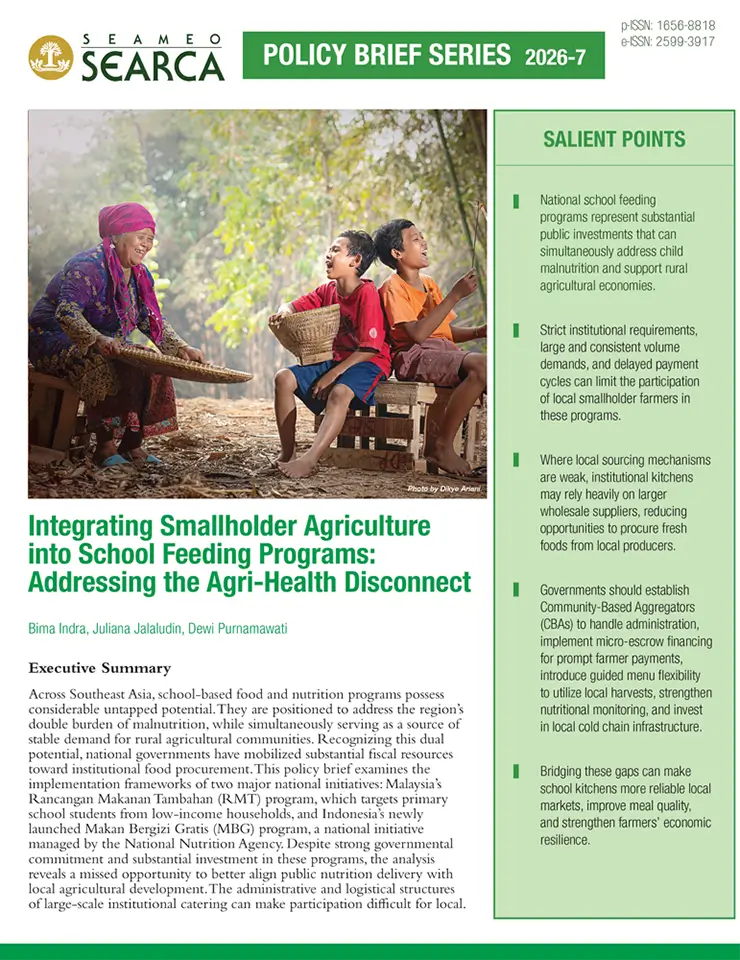 Rather than expecting individual farmers, school principals, or kitchen operators to negotiate the full complexity of institutional procurement, CBAs could bridge fragmented local production and the volume and administrative requirements of school feeding programs.
The brief recommends formally integrating such aggregators, including cooperative entities, into procurement systems. It also stresses the need for oversight so that CBAs operate equitably as community assets rather than becoming another layer of profit-extracting intermediation.
The authors also propose state-backed CBA micro-escrow funds that would allow farmers to receive prompt payment when they deliver produce. The aggregator would manage the longer government reimbursement cycle, with the fund replenished once government payment is received.
Such an arrangement could address one of the most immediate obstacles to smallholder participation: the inability of farmers to wait several weeks for payment after delivering their crops.
Making school menus work with local harvests
The brief further calls for guided menu flexibility so school kitchens can make greater use of seasonal and locally available foods while continuing to meet nutritional requirements.
Highly prescriptive menus may promote nutritional consistency but can also prevent kitchens from taking advantage of locally abundant produce. The brief illustrates the problem with a simple scenario in which a centralized menu requires cabbage while a locality has a surplus of amaranth, yet the kitchen may still be required to purchase cabbage instead of drawing on the available local crop.
The authors recommend allowing local implementers to make appropriate substitutions as long as meals continue to meet predetermined Recommended Dietary Allowance targets. Such flexibility could help school feeding programs absorb agricultural surpluses, respond to price fluctuations, and create more opportunities for nearby farmers.
The policy brief also recommends strengthening nutritional monitoring beyond administrative and sanitation compliance to determine whether nutritional quality is maintained throughout food handling and preparation.
Investment in localized cold chain infrastructure is another priority. Community-level temperature-controlled storage and transport could reduce postharvest losses while helping preserve sensitive nutrients as fresh foods move from farms to institutional kitchens.
From academic mobility to policy-relevant knowledge
The research also demonstrates how academic mobility can serve as a pathway from learning to policy engagement. Rather than treating mobility simply as an opportunity to travel or study in another institution, SEARCA's grant provides researchers with opportunities to undertake research across institutions and settings, gain exposure to new approaches, and work with academic and research expertise beyond their home institutions.
For Bima Indra, the mobility-supported research brought together evidence from Malaysia and Indonesia around a development problem that crosses traditional sectoral boundaries, showing how nutrition programs can simultaneously support healthier children and more inclusive agricultural economies.
This approach is also consistent with SEARCA's 12th Five-Year Development Plan focused on Sustainable Transformation of Agricultural Systems through Innovation in Southeast Asia (SUSTAIN Southeast Asia), which places education, capacity building, and youth engagement among its four key priority areas and identifies the sustained empowerment of farmers, stakeholders, and institutions as its "People" development outcome.
The resulting policy brief shows one way these priorities can converge by supporting researchers to move across borders, examine common regional challenges in their actual implementation settings, and translate the knowledge gained into recommendations that can inform policy and practice.
Turning school meals into local development investments
The brief concludes that school feeding programs should be viewed not simply as large-scale catering operations but as long-term investments in human capital with the potential to generate broader rural development benefits.
It calls on national nutrition agencies, ministries of education, and regional agricultural departments to pilot localized procurement frameworks combining community-based aggregation, financing mechanisms, menu flexibility, stronger nutritional monitoring, and cold chain investment.
By connecting school kitchens more effectively with smallholder agriculture, governments could make public spending on food work in two directions: delivering nutritious meals to children while creating more inclusive and dependable markets for the farming communities that produce food.
For SEARCA, the publication also completes an important knowledge cycle behind academic mobility by supporting cross-border learning and research, generating evidence from Southeast Asian settings, and bringing that evidence back into the region as knowledge that can contribute to better development policy and practice.