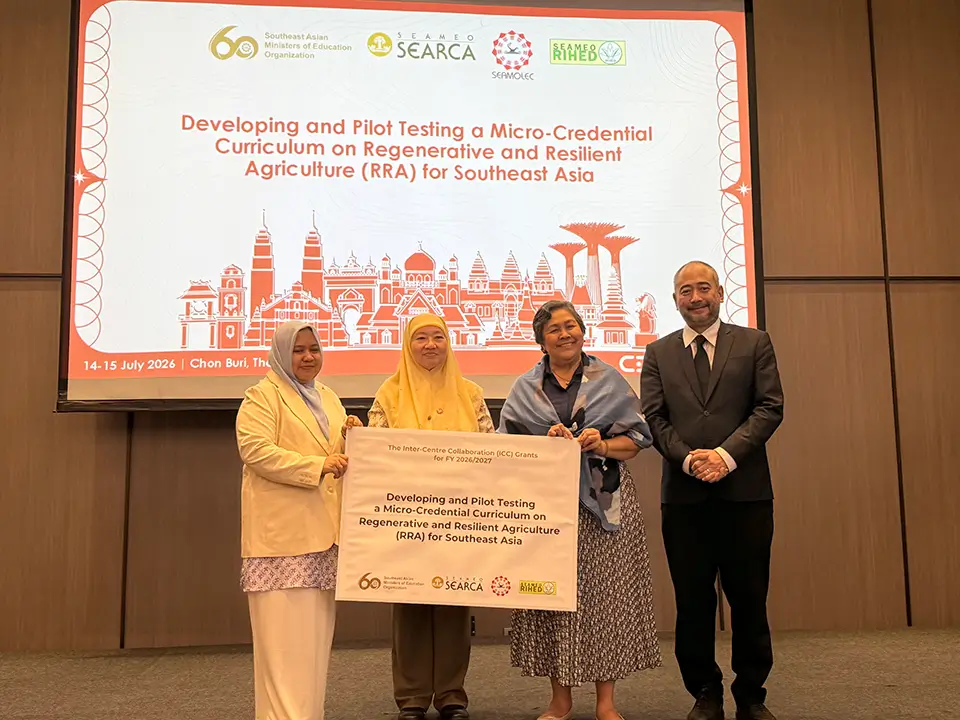
 Datuk Dr. Habibah Abdul Rahim, Director of the SEAMEO Secretariat (second from left), presents the SEAMEO Inter-Centre Collaboration Grant to SEARCA Center Director Mercedita Sombilla (second from right), together with representatives of partner centers SEAMEO SEAMOLEC and SEAMEO RIHED during the SEAMEO Centre Directors Meeting (CDM) held on 14–15 July 2026 in Chon Buri, Thailand.
LOS BAÑOS, Philippines—The Southeast Asian Regional Center for Graduate Study and Research in Agriculture (SEARCA) will lead the design and testing of a regional micro-credential curriculum on regenerative and resilient agriculture in partnership with two other centers of the Southeast Asian Ministers of Education Organization (SEAMEO). The 12-month initiative is funded by the SEAMEO Inter-Centre Collaboration (ICC) Grant.
SEARCA, the SEAMEO Regional Open Learning Centre (SEAMOLEC), and the SEAMEO Regional Centre for Higher Education and Development (RIHED) were selected under the first round of the SEAMEO ICC Grant, which funds collaborative initiatives addressing shared regional priorities. Their project, "Developing and Pilot Testing a Micro-Credential Curriculum on Regenerative and Resilient Agriculture for Southeast Asia," responds to the growing regional need for structured, competency-based training in regenerative farming practices.
The project supports the Association of Southeast Asian Nations (ASEAN) Food, Agriculture and Forestry Sectoral Plan 2026–2030, which identifies sustainable and regenerative measures, decarbonization, and climate resilience among its focus areas. It also aligns with SEAMEO priorities on technical and vocational education and training (TVET), climate resilience, food security, and higher education.
Training on regenerative agriculture remains uneven across Southeast Asia. Opportunities are often tied to short-term donor-funded projects or private-sector programs, while many universities, TVET institutions, and extension agencies lack structured materials for regular courses and professional training. Such training is increasingly urgent as climate-related disasters and extreme temperatures threaten agricultural productivity and rural livelihoods.
The project will produce an open-access, competency-based course for agricultural educators, TVET trainers, extension workers, and early-career practitioners. It will comprise three self-paced modules covering the foundations of regenerative agriculture; regenerative farming practices and agroecological systems; and climate-adaptive farm planning and implementation. Topics may include cover cropping, minimal tillage, composting, agroforestry, integrated pest management, water retention, soil restoration, and farm-level biodiversity.
Work will begin with a rapid training needs assessment in the Philippines, Indonesia, and Thailand. Universities, TVET providers, extension specialists, and industry representatives will help identify the knowledge and practical skills needed across different agricultural settings. SEARCA and its partners will also review existing curricula, ASEAN priorities, and national qualifications frameworks before finalizing the course competencies and learning outcomes.
Universities, TVET centers, extension agencies, and other organizations will be able to use or adapt the modules at no cost. The modules will be released as open educational resources and delivered through a mobile-friendly online platform.
At least 30 learners from the Philippines, Indonesia, and Thailand will participate in the pilot test. Their feedback and learning results will guide revisions before the course is publicly released. The project will encourage the participation of women, rural practitioners, Indigenous Peoples, and other underrepresented groups.
SEARCA will manage the project and lead the training needs assessment, competency framework, curriculum development, module writing, quality assurance, and pilot testing in the Philippines. SEAMOLEC will convert the technical content into self-paced online modules, host the course on its learning management system, provide technical and learner support, and organize the pilot test in Indonesia. RIHED will advise on quality assurance, assessment, alignment with national qualifications frameworks, credit transfer, and possible pathways to institutional recognition.
The project will document lessons in competency-based curriculum design, quality assurance, qualifications framework alignment, and potential recognition pathways for agricultural micro-credentials. These findings may inform regional discussions on how short, focused courses can be recognized, combined, or credited toward formal qualifications. Broader institutional adoption and cross-country portability remain longer-term goals requiring sustained policy dialogue and cooperation.
The initiative supports Sustainable Transformation of Agricultural Systems through Innovation in Southeast Asia (SUSTAIN Southeast Asia), the central theme of SEARCA's 12th Five-Year Development Plan for FY 2025/2026–2029/2030. It reflects SEARCA's commitment to building more resilient, innovative, and inclusive agricultural systems that strengthen food and nutrition security across the region.
By combining regenerative agriculture, flexible learning, and regional collaboration, the micro-credential translates this commitment into accessible, practical training for educators and practitioners. It also contributes to the United Nations Sustainable Development Goals (SDGs) on quality education, zero hunger, and climate action.