LOS BAÑOS, Philippines—The Rice Competitiveness Enhancement Fund-Rice Extension Services Program (RCEF-RESP) under the Philippine Department of Agriculture – Agricultural Training Institute (DA-ATI) has produced measurable improvements in rice farm productivity and profitability, according to the results of a nationwide endline evaluation.
During the "Keeping on Track: ATI's FY 2025 Annual Performance Review and FY 2026 Commitment Signing" on 27 January 2026 at The Hive Hotel and Convention Place, the Southeast Asian Regional Center for Graduate Study and Research in Agriculture (SEARCA) presented the findings of the project "Reaping the Benefits: Evaluation of RCEF-RESP 2019-2024." Led by Project Team Leader Dr. Ernesto Brown, the study assessed the program's impact following the enactment of Republic Act No. 11203 or the Rice Tariffication Law. The event was attended by representatives from all Regional ATI Training Centers and ATI Central Office officials, including Engr. Remelyn Recoter, Director IV, and Ms. Milagros Urbano, Chief Policy and Planning Division.
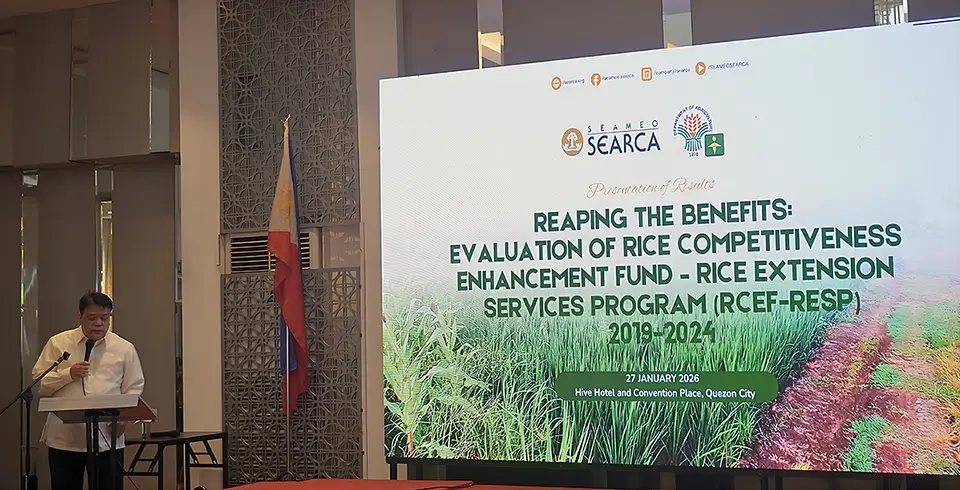 Dr. Ernesto Brown presents the results of the evaluation to DA-ATI officials and representatives.
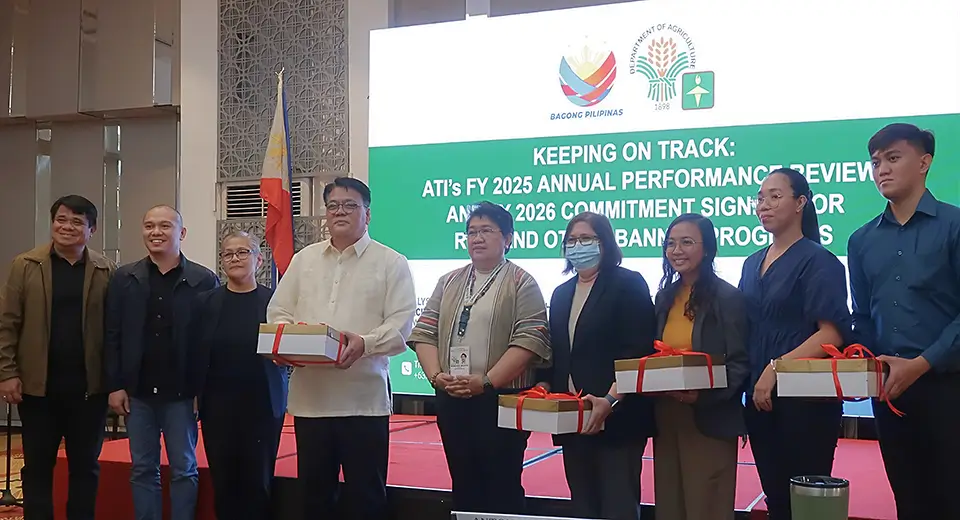 Dr. Ernesto Brown (fourth from left), Project Team Leader; Dr. Fezoil Luz Decena (fourth from right), Agriculture and Fisheries Extension Expert; Agriculturist Ivy Rosemarie Ortiguero (third from right), Technical Writer; and Ms. Abby Grace Bermejo (second from right) and Mr. Jasper Dane Dela Cueva (rightmost), both SEARCA project staff, receive tokens from DA-ATI following their presentation. (Photo by DA-ATI Central Luzon)
The presentation highlighted that the program delivered extension services at scale, reaching more than 300,000 farmers, trainers, and extension intermediaries across the country's 57 priority rice-producing provinces. The evaluation found higher adoption rates of science-based rice production practices among beneficiaries, including the use of certified inbred seeds, improved crop establishment and nutrient management, pest and disease control, and the acquisition of mechanization-related skills. Learning sites for agriculture (LSAs) and farmer field schools (FFS) played key roles in hands-on learning and local technology adaptation.
At the institutional level, the program strengthened local extension systems by developing LSAs, enhancing the training of extension intermediaries, and improving coordination among the ATI, Philippine Rice Research Institute (PhilRice), Philippine Center for Postharvest Development and Mechanization (PhilMech), Technical Education and Skills Development Authority (TESDA), local government units, and farmer organizations.
Overall, the evaluation concluded that RCEF-RESP is a relevant and effective public investment. The study recommends strengthening post-training support; harmonizing monitoring systems across agencies; clarifying inter-agency roles; and improving convergence with credit, insurance, mechanization, and market support to sustain and expand program gains.
SEARCA underscores its commitment to supporting evidence-based decision-making for sustainable agricultural and rural development in the Philippines. By demonstrating how interventions directly improved farmer productivity and income and food security, the evaluation project provides a foundation for scaling these gains. Furthermore, the RCEF-RESP's success in promoting science-based practices and institutional coordination aligns with SEARCA's other goals of fostering climate resilience and empowering agricultural stakeholders.