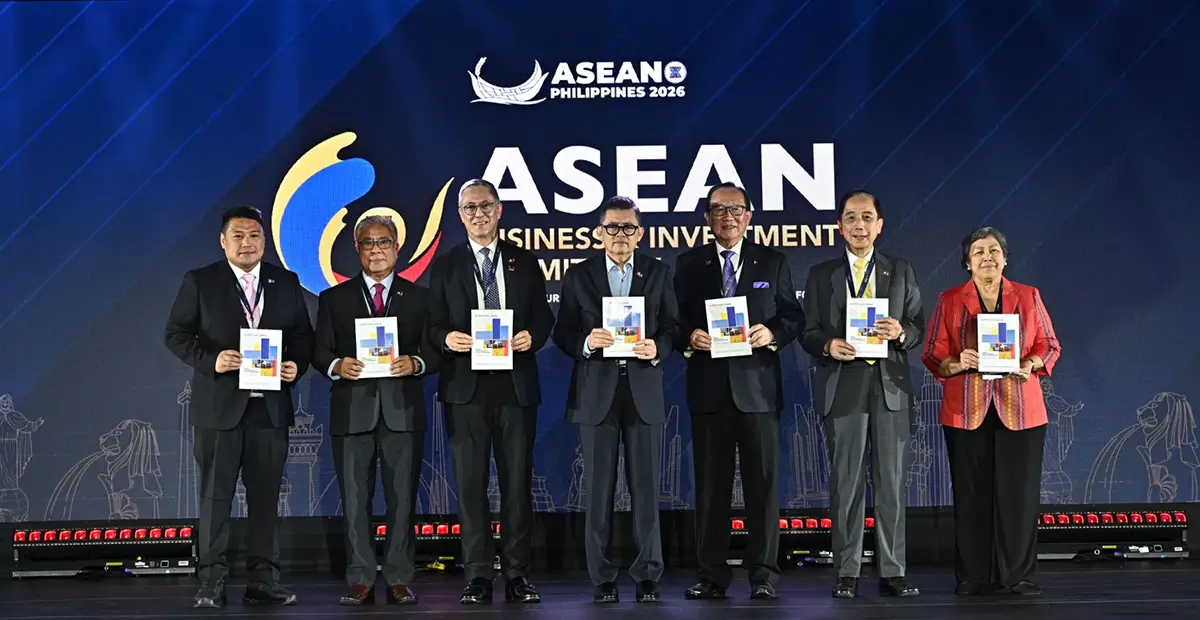
 From left: James Amparo and Gil Gonzales, Senior Advisers for the ASEAN Food Security Alliance (AFSA), ASEAN-BAC Philippines; Michael Tan, ASEAN-BAC Member; Jose Ma. “Joey” Concepcion III, ASEAN-BAC 2026 Chairman; George Barcelon, ASEAN-BAC Member; Dr. William Dar, Lead Senior Adviser for Agriculture and Food Security and AFSA, ASEAN-BAC Philippines; and Dr. Mercedita Sombilla, SEARCA Center Director, hold copies of the ASEAN Food Security Policy Framework Executive Summary at the ASEAN Business and Investment Summit (ABIS) 2026 at Solaire Resort in Parañaque City, Philippines on 14 November 2026. The Framework, co-developed by SEARCA and ASEAN-BAC Philippines, is a legacy document of AFSA and ASEAN-BAC under the Philippines' 2026 ASEAN chairship. (Photo courtesy of ASEAN-BAC Philippines)
MANILA, Philippines—The Southeast Asian Regional Center for Graduate Study and Research in Agriculture (SEARCA) has contributed to the legacy of the Philippines' 2026 ASEAN chairship through its co-development of the ASEAN Food Security Policy Framework with the ASEAN Business Advisory Council (ASEAN-BAC) Philippines. The Framework calls for stronger private sector investment and inclusive partnerships to advance regional food security.
A legacy document of the ASEAN Food Security Alliance (AFSA) and ASEAN-BAC under the Philippines' 2026 ASEAN chairship, the Framework was showcased at the ASEAN Business and Investment Summit (ABIS) 2026 on 14 November 2026 at Solaire Resort in Parañaque City, Philippines.
Attended by SEARCA Center Director Dr. Mercedita Sombilla, the summit was organized by ASEAN-BAC under the theme "Navigating Our Future Together: Advancing Prosperity for All." It brought together ASEAN leaders, business executives, investors, and experts to discuss regional economic growth, investment opportunities, and strategic partnerships. Food security was among the key areas of discussion, alongside energy security, digital transformation, artificial intelligence, and inclusive economic development.
The Framework was earlier launched at the ASEAN Food Security and Agribusiness Summit 2026 held at LANDBANK Plaza in Manila on 10 October 2026. Organized by ASEAN-BAC Philippines under its "Prosperity for All" agenda, the summit brought together regional leaders, policymakers, and private sector representatives to advance collective action on food security.
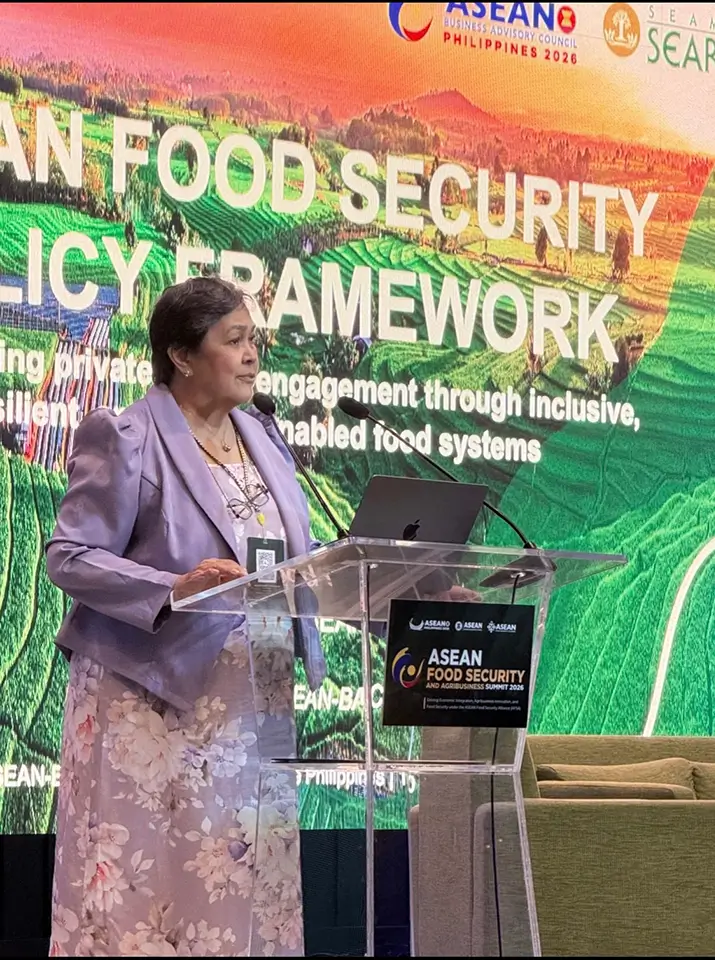 SEARCA Center Director Dr. Mercedita Sombilla presents the ASEAN Food Security Policy Framework, co-developed by SEARCA and ASEAN-BAC Philippines, at the ASEAN Food Security and Agribusiness Summit 2026 in Manila, Philippines on 10 October 2026. (Photo courtesy of ASEAN-BAC Philippines)At the October summit, Sombilla presented the Framework, which was developed in coordination with AFSA, outlining policy recommendations to mobilize investment, strengthen agricultural value chains, and expand opportunities for smallholder farmers and rural enterprises.
The Framework builds on earlier consultations, including a high-level roundtable in May 2026 where SEARCA and ASEAN-BAC Philippines engaged stakeholders in refining the proposed policy directions.
SEARCA's role in developing the Framework advances its 12th Five-Year Development Plan, Sustainable Transformation of Agricultural Systems through Innovation in Southeast Asia (SUSTAIN Southeast Asia). By linking agricultural policy reform and private investment with inclusive and sustainable development, the Framework supports the Plan's four intended outcomes: higher farmer incomes (Pocket), improved food and nutrition security (Plate), more resilient agricultural systems (Place), and empowered agricultural stakeholders and institutions (People). It also reflects SEARCA's commitment to translating research-based evidence into policies and partnerships that benefit agricultural communities across the region.
Four pathways for private sector engagement
In her 10 October presentation, "Strengthening Private Sector Engagement through Inclusive, Resilient, and Market-Enabled Food Systems," Sombilla identified four complementary pathways for strengthening regional food security.
These focus on improving agricultural productivity and innovation through climate-resilient technologies, affordable farm inputs, and research; expanding smallholder market access through stronger producer organizations and commercial linkages; strengthening agricultural value chains through investments in storage, logistics, and processing; and mobilizing finance and technology through blended financing, insurance, and digital services.
The Framework recognizes that Southeast Asia's food security challenges extend beyond agricultural production to ensuring reliable and affordable access to nutritious food. Persistent barriers include postharvest losses, inadequate rural infrastructure, limited financing, fragmented trade requirements, and mounting climate risks.
Five policy priorities for regional action
To address these constraints, the Framework proposes five mutually reinforcing policy priorities, including a Smallholder Inclusive Accreditation scheme to encourage responsible agribusiness investment, streamlined regional agrifood trade through harmonized standards and electronic certification, and a proposed USD 500 million to USD 1 billion ASEAN blended finance facility for agricultural infrastructure, innovation, and climate resilience.
Other priorities seek to strengthen regional food crisis coordination, agricultural research, and climate innovation while safeguarding land rights, environmental sustainability, and meaningful smallholder participation.
Central to the recommendations is the promotion of Public–Private–Producer–People Partnerships (5Ps), which bring together governments, businesses, producer organizations, and communities in planning, investment, implementation, and accountability.
The approach emphasizes shared decision-making, fair contracts, risk sharing, and measurable benefits for farmers and rural communities, ensuring that private investment supports both commercial viability and inclusive agricultural development.
From policy to implementation
The Framework proposes phased implementation, beginning with regulatory improvements, accreditation mechanisms, and pilot initiatives in priority agricultural commodities and investment corridors.
Progress would be measured through indicators such as reduced postharvest losses, improved smallholder incomes, increased private investment, more efficient regional trade, and stronger food and nutrition security.
Under the proposed arrangements, ASEAN-BAC would help mobilize business participation and investment, while AFSA would coordinate technical implementation and monitoring. ASEAN member states and relevant ASEAN bodies would retain regulatory and oversight responsibilities. SEARCA could further contribute research-based evidence, knowledge exchange, and capacity building, subject to agreement on its specific implementation role.
Through its collaboration with ASEAN-BAC Philippines and its contribution to this legacy document, SEARCA has helped lay the groundwork for sustained regional cooperation on food security beyond the Philippines' 2026 ASEAN chairship. The Framework connects private investment and agricultural innovation with smallholder inclusion and public accountability. Its implementation would depend on sustained cooperation among governments, businesses, producers, and communities to translate its recommendations into measurable improvements in Southeast Asia's food and nutrition security.