LOS BAÑOS, Philippines—Eighteen undergraduate agribusiness students from Tokyo University of Agriculture (Tokyo NODAI), accompanied by Prof. Dr. Nina Nocon-Shimoguchi and faculty members from the Department of Agribusiness Management and Entrepreneurship, University of the Philippines Los Baños, visited the Southeast Asian Regional Center for Graduate Study and Research in Agriculture (SEARCA) on 10 August 2026 to learn about the Center's programs and initiatives.
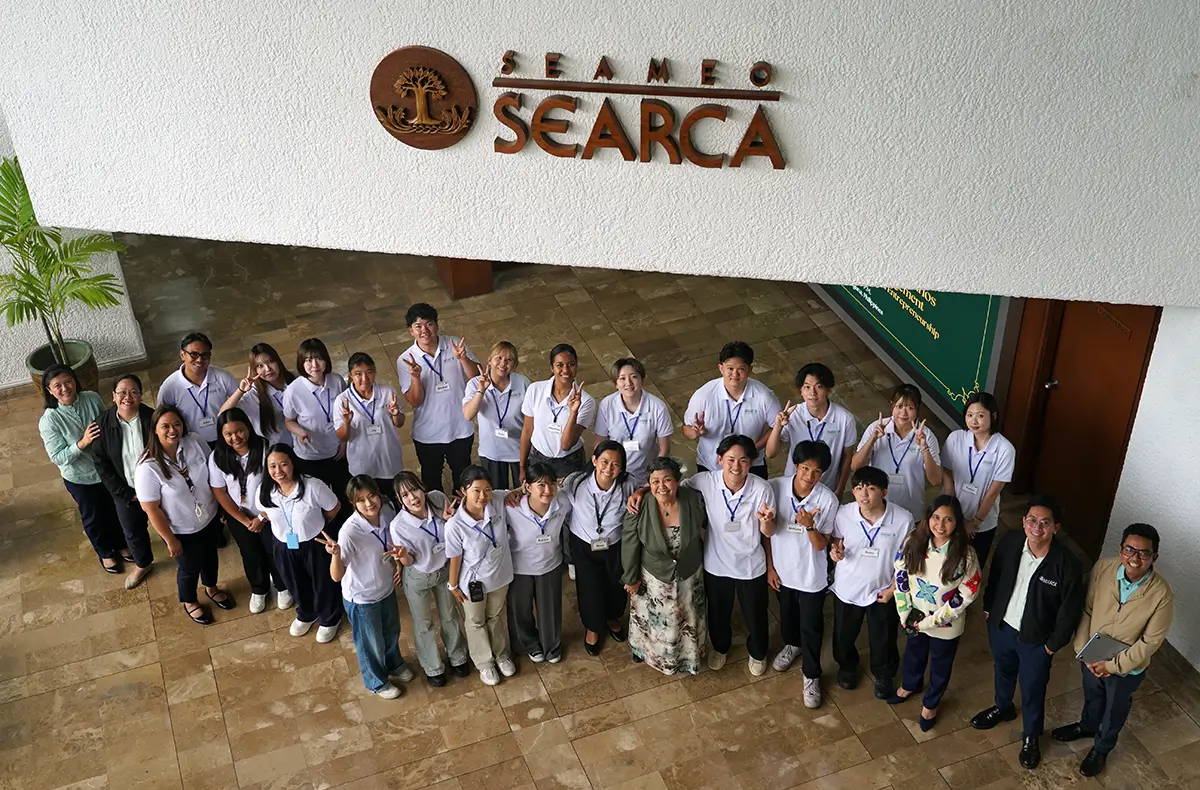
Nocon-Shimoguchi expressed appreciation for the long-standing partnership between Tokyo NODAI and SEARCA, noting that 2026 marks the 27th year of the university's Philippine Field Practice. She also highlighted how the visit coincides with the 70th anniversary of the normalization of diplomatic relations between the Philippines and Japan, with 2026 officially designated as the Philippines-Japan Friendship Year.
Dr. Mercedita Sombilla, SEARCA Center Director, welcomed the visitors and underscored the role of the younger generation in transforming agrifood systems. She emphasized the Center's aspiration for youth to understand and appreciate that agriculture extends beyond food production to encompass people, communities, economies, and the environment.
"When agriculture thrives, it creates jobs, lifts rural economies, and boosts food security. When it faces challenges such as climate change, market volatility, and emerging pests and diseases, it threatens communities as a whole," Sombilla said.
She explained that understanding agriculture requires looking more broadly at agrifood systems and examining the entire value chain—from how food is produced and processed to how research and policy shape these processes.
She challenged the students to become future agricultural leaders who can bridge science and practice and help translate policies into solutions that respond to real-world needs.
The visitors were then briefed on SEARCA's three main mandates—graduate scholarships, policy research, and agricultural technology dissemination—and its departments: Education and Collective Learning, Research and Thought Leadership, and Emerging Innovation for Growth.
Ms. Bernice Anne De Torres, Program Coordinator at the Research and Thought Leadership Department, introduced SEARCA's research agenda. She explained that it is anchored in the Center's 12th Five-Year Development: Sustainable Transformation of Agricultural Systems through Innovation in Southeast Asia (SUSTAIN Southeast Asia) and its 4Ps framework: boosting farmer incomes (Pocket), enhancing food security (Plate), building climate resilience (Place), and empowering the next generation of stakeholders (People).
She then presented SEARCA's flagship initiatives, focusing on policy research for sustainable and inclusive agricultural transformation in Southeast Asia. These include the Consortium for Agricultural Policy Research Initiatives (CAPRI), a network of high-caliber policy research institutions that links science, policy, and practice; and the Southeast Asia Agricultural Outlook Series, which generates timely, evidence-based insights and actionable policy recommendations to support informed decision-making.
De Torres also discussed ongoing research projects, such as the Ensuring Inclusiveness, Sustainability, and Efficiency of Food System Transformation in the ASEAN and BIMSTEC Countries (ATMI II), the second phase of the International Fund for Agricultural Development (IFAD)-funded Agricultural Transformation and Market Integration in the ASEAN Region (ATMI-ASEAN) project; the Policy Analysis and Cost Assessment of Healthy Diets in Cambodia, Nepal, the Philippines, and Sri Lanka; and Strengthening the Enabling Environment for the Development and Uptake of Modern Agricultural Biotechnology (SEED) project She also highlighted SEARCA's joint forum series with the University of Asia and the Pacific on food and agribusiness.
Meanwhile, Dr. Emil John Cabrera, Program Head of SEARCA's Emerging Innovation for Growth Department (EIGD), presented an overview of the Center's programs for accelerating agricultural transformation across Southeast Asia.
For open innovation and agri-incubation, he highlighted several regional initiatives, including the Grants for Research towards Agricultural Innovative Solutions (GRAINS), a seed-funding initiative that supports scalable field-level innovations. These include artificial intelligence (AI)-powered smart fish feeders in Malaysia, black soldier fly farming in the Philippines, and circular bioplastic development. Cabrera also presented the ACCELERATOR Program, which provides startups with hands-on support in diagnostics, mentorship, market reach, and networking. Partnerships under this initiative include collaborations with enterprises such as Ermera Ai-Kulat Mutin Organiku in Timor-Leste, which promotes mushrooms as a source of protein, and The Green Co. Ltd. in Lao PDR, which promotes poultry-based livelihoods for women. SEARCA also organizes agri-tech marketplace, innovation, and exchange events.
For knowledge and technology transfer, Cabrera talked about an open-systems tractor design featuring modular, customizable machinery that can be locally fabricated and adapted to specific farm conditions, as well as agri-robotics and AI-driven solutions that support precision, efficiency, and reduced labor requirements while remaining affordable and accessible to smallholder farmers. He also showcased the Rice Straw Bioenergy Hub (RSBH), which converts rice straw and other agricultural residues into bioenergy, biochar, compost, and mushroom substrates as alternatives to open-field burning.
The session concluded with an open forum, during which the students asked about Southeast Asian farmers' mechanization needs and willingness to adopt smart technologies.
The students toured the SEARCA Hub for Agriculture and Rural Innovation for the Next Generation (SHARING) AgriMuseum, which features interactive exhibits on agriculture and rural development.
Building on the institutions' enduring partnership, SEARCA hosted the 36th batch of Tokyo NODAI students for their Philippine Field Practice. Through discussions on agricultural policy, innovation, and agribusiness, the visit gave the students a closer look at Southeast Asia's evolving agricultural landscape and SEARCA's work to address challenges across agrifood systems.
For six decades, SEARCA has advanced agricultural graduate education, research, innovation, and knowledge exchange by working with academic institutions, governments, international development organizations, private agribusiness firms, and farming communities across the region.