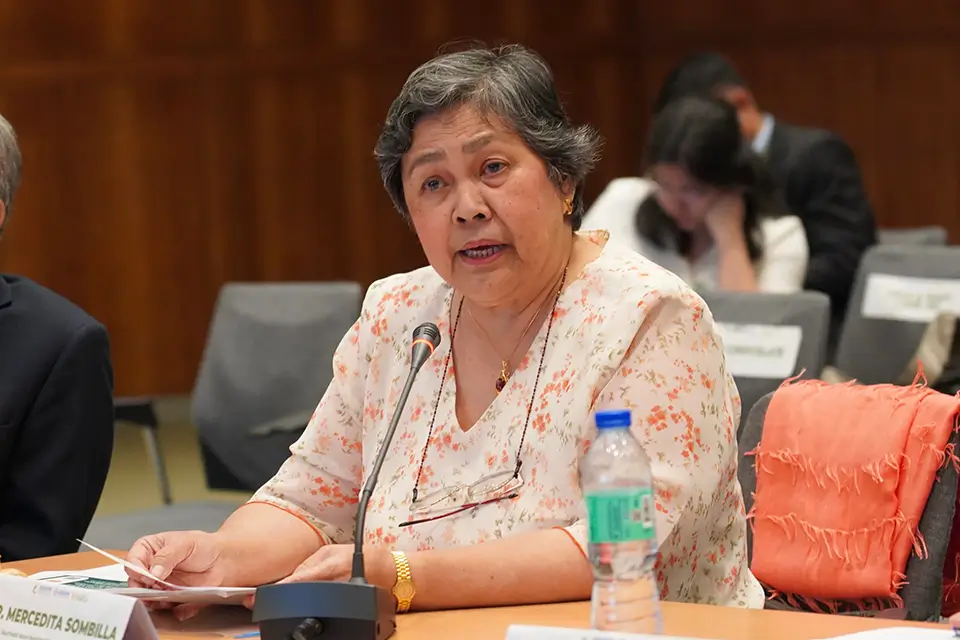
MANILA, Philippines—Days ahead of the 48th ASEAN Summit in Cebu, Philippines, the Southeast Asian Regional Center for Graduate Study and Research in Agriculture (SEARCA), in partnership with the ASEAN Business Advisory Council (ASEAN-BAC) Philippines, unveiled their proposed ASEAN Food Policy Framework aimed at reshaping regional food systems through private sector leadership and innovation. Dr. Mercedita Sombilla, SEARCA Center Director, presented the framework at a high-level multi-stakeholder roundtable discussion held on 4 May 2026 at the LANDBANK Plaza.
The recommended policy framework reframes food security as a multidimensional challenge encompassing production, resilience, inclusivity, and sustainability across ASEAN. A priority initiative under the Philippines' ASEAN chairmanship, it seeks to establish a regionally harmonized, private sector-led food security strategy anchored on strengthened Public-Private-Producer Partnerships (4Ps) and innovation-driven approaches. This framework aligns with existing ASEAN food security commitments while uniquely positioning the private sector as the primary engine for cross-border harmonization and technology-led transformation.
In his welcome message, Mr. Jose Ma. "Joey" Concepcion III, ASEAN-BAC Chair and Go Negosyo Founder, described the sector as carrying the "wealth of poverty", underscoring both its challenges and its untapped potential for inclusive growth. He highlighted that while agriculture remains one of the most challenging businesses due to climate risks, pests, and diseases, it also holds the greatest potential for inclusive growth when supported by experienced private-sector actors, whom he referred to as "big brothers."
Noting the partnerships to be formalized during the event, Concepcion also stressed that the regional initiatives, such as the legacy project ASEAN Food Security Alliance (AFSA), must go beyond formal agreements. He added that meaningful impact requires sustained commitment, implementation, and collaboration.
Providing the event's policy context, Dr. William Dar, ASEAN-BAC Philippines Senior Adviser, outlined three strategic pillars underpinning AFSA: agribusiness partnerships and joint ventures, technology transfer and innovation, and policy formulation. Dar emphasized that the framework responds to increasing global and regional disruptions, including geopolitical tensions, climate-related disasters, and supply chain vulnerabilities, that continue to threaten food security in Southeast Asia. He further highlighted the importance of evidence-based policymaking and broad stakeholder consultation to ensure that the framework gains traction within the ASEAN-level decision-making process.
The roundtable served as both a venue for the presentation and a platform for participating stakeholders to shape the framework's direction. Following Sombilla's presentation, Dar moderated a Multi-Stakeholder Response Session, where representatives from 24 Philippine government agencies, businesses, producers, and famer groups provided substantive feedback and insights aimed at refining the framework and ensuring its alignment with national priorities and development commitments.
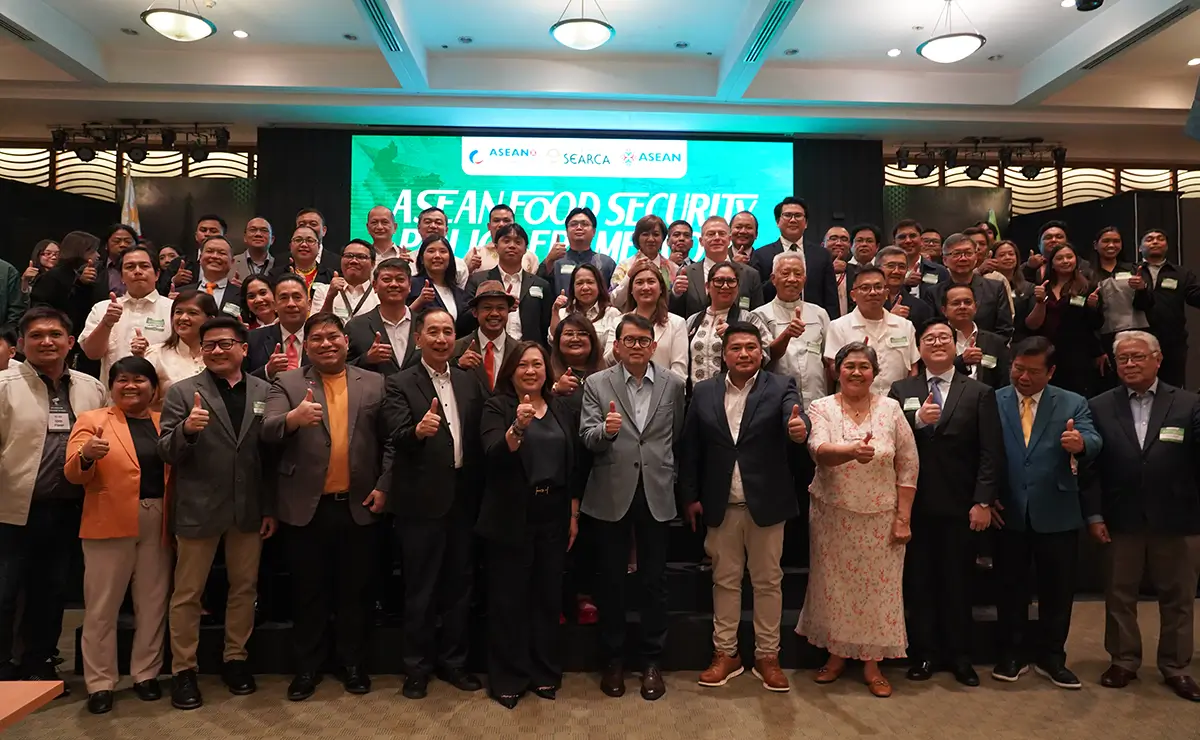
Government offices that participated in the session included the Department of Agriculture (DA) and its attached agency, the National Food Authority (DA-NFA); the Philippine Economic Zone Authority (PEZA) and Board of Investments (-BOI) under the Department of Trade and Industry (DTI); Department of Agrarian Reform (DAR); National Commission on Indigenous Peoples (NCIP); Provincial Government of Quezon; Landbank of the Philippines (LBP); and Dr. Leocadio Sebastian, who clarified that his feedback was independent of his role as the Acting President and Chief Executive Officer of the Development Academy of the Philippines (DAP).
Meanwhile, businesses and other stakeholder groups that joined the session included Harbest Agribusiness Corporation, Central Azucarera de Tarlac, Syntegral Global Solutions, Philippine Rice Industry Stakeholders Movement (PRISM), Planters Products, Inc. (PHILPRO), SGV & Co., KMV Asia Development Corporation, SL Agritech, Mga Anak ni Inang Daigdig, Philippine Chamber of Agriculture and Food, Inc. (PCAFI), FeedMix, AGREA Foundation, Varacco, and the Yakap at Halik Multi-Purpose Cooperative based in Quezon.
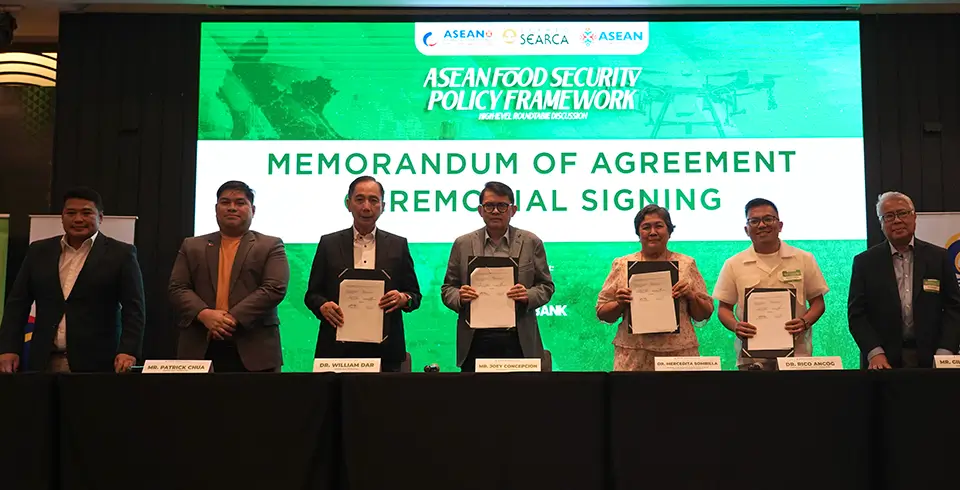
During the program, SEARCA and ASEAN-BAC Philippines also signed a five-year memorandum of understanding (MOU) to formalize their cooperation. The partnership, catalyzed by the development of the proposed policy framework, reaffirms both organizations' commitment to advancing data-driven, innovation-led, and sustainability-focused approaches to regional food security. Joining Concepcion and Sombilla as witnesses to the MOU ceremonial signing were Dar and Dr. Rico Ancog, SEARCA Deputy Director for Administration.
Through this collaboration, SEARCA and ASEAN-BAC Philippines aim to ensure that ASEAN food security strategies move beyond policy into coordinated actions, strengthening food systems, empowering smallholders, and fostering resilient, inclusive agricultural and rural development across the region.