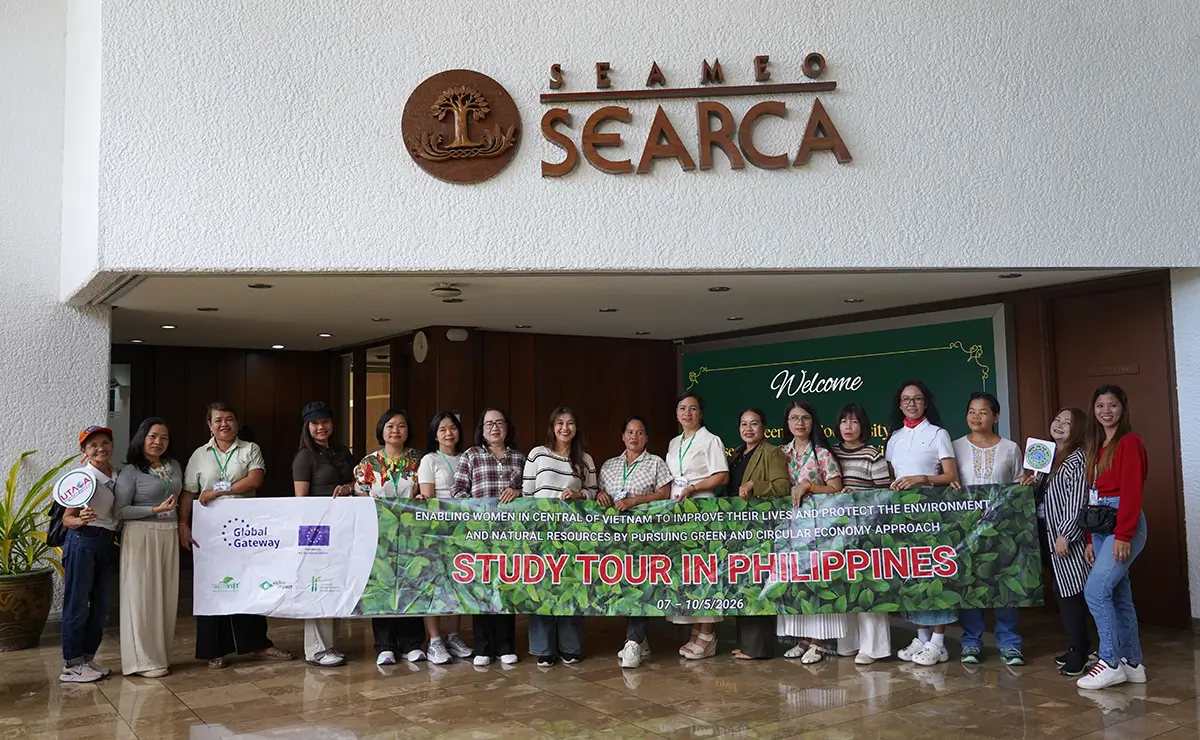
LOS BAÑOS, Philippines—A delegation from the project Enabling women in Central Vietnam to improve their lives and protect the environment and natural resources by pursuing a green and circular economy approach visited the Southeast Asian Regional Center for Graduate Study and Research in Agriculture (SEARCA) on 8 May 2026. This initiative is funded by the European Union (EU) and implemented by GreenViet Biodiversity Conservation Centre (GreenViet), Visible Impact, and the EU Corporate Sustainability Reporting Directive (CSRD). The delegation comprised female leaders from city- and commune- and ward-level local governments, members of cooperatives, and community representatives from Da Nang, Vietnam.
The project aims to empower women in Central Vietnam to improve their livelihoods while protecting the environment and natural resources through the application of green and circular economy approaches. The delegation visited the Philippines to learn about production and processing models including community-based tourism that applies green and circular economy principles.
During the visit, they were introduced to several initiatives under SEARCA's core programs—Education, Research, and Innovation—with a strong focus on circular agriculture and youth engagement.
For circular agriculture, Ms. Maria Carla Dolores, Research and Thought Leadership Senior Program Associate, presented the ASEAN Partnership for Sustainable Aquaculture (AquASEAN) project, a regional initiative led by the French Agricultural Research Centre for International Development (CIRAD), SEARCA, the Association of Southeast Asian Nations (ASEAN) Secretariat, and partner universities. AquASEAN promotes circular, climate-responsible aquaculture systems that emphasize waste reduction, nutrient recycling, and resource efficiency while advancing capacity building and regional policy support for sustainable aquaculture.
Dr. Emil John Cabrera, Program Head of SEARCA's Emerging Innovation for Growth Department (EIGD), presented the Rice Straw Bioenergy Hub (RSBH) in the Philippines as a flagship case study in circular agriculture and closed-loop systems. The RSBH aims to transform rice straw, which is traditionally burned or incorporated into the soil, into valuable products, including mushroom substrates, mulching materials, animal bedding, and bioenergy in the form of biogas and biochar.
Cabrera also highlighted SEARCA's work on agri-mechanization and artificial intelligence as key enablers of circular and climate-resilient food systems. Among the innovations he introduced were an open-systems tractor design featuring modular, customizable machinery that can be locally fabricated and adapted to specific farm conditions, as well as agri-robotics and AI-driven solutions that support precision, efficiency, and reduced labor requirements, while remaining affordable and accessible to smallholder farmers.
On youth engagement, Ms. Loise Ann Carandang, Senior Associate for Partnerships and Linkages at the Partnerships Unit (PU), discussed SEARCA's MS and PhD scholarship offerings, which enable young professionals to pursue advanced studies in agriculture and related sciences and equip them to become the next generation of agricultural leaders.
She spotlighted the Young Forces for Agricultural Innovation (#Y4AGRI), SEARCA's banner youth engagement program. Under #Y4AGRI, the SEARCA youth staff organize learning events such as webinars on youth-led innovations in local agrifood systems and career orientations that reposition agriculture as an enticing and viable career path. Other #Y4AGRI activities include the Youth Stories Competition, which showcased successful young agripreneurs, and the Youth in Agri Talk Show, which uses non-conventional approaches to introduce basic education students to agriculture. Carandang's presentation also underscored SEARCA's commitment to gender-inclusive leadership, citing the Center's active involvement in women-focused capacity building activities, such as the conferences on Women Empowerment and Leadership (WELA) in Agriculture, Aquatic, and Natural Resources.
In its 12th Five-Year Development Plan: Sustainable Transformation of Agricultural Systems through Innovation in Southeast Asia (SUSTAIN Southeast Asia), SEARCA continues to play a role in community empowerment, evidence generation for climate-smart and digital agriculture, innovation incubation, and policy support, offering concrete models that can inform GreenViet's work in Central Vietnam.
The Center hosts international learning visits, such as this one, to facilitate knowledge exchange and the sharing of best practices, thereby supporting the sustainable transformation of agricultural systems across Southeast Asia through innovation, inclusivity, and strong regional partnerships.