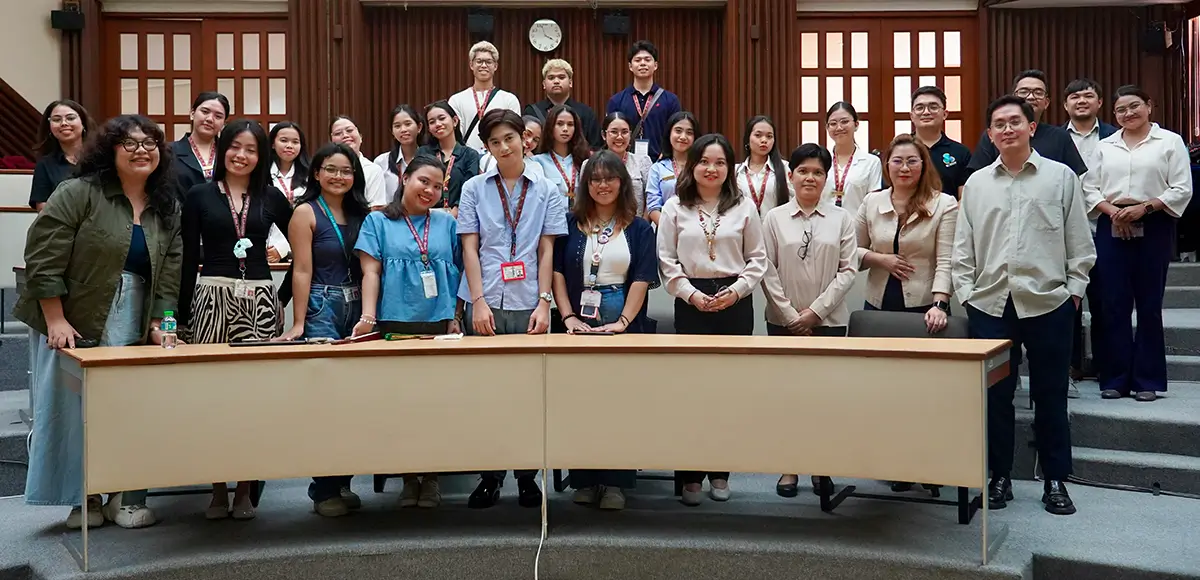
LOS BAÑOS, Philippines—A delegation of 19 development communication (DevCom) student interns from Zamboanga Peninsula Polytechnic State University (ZPPSU), Mindanao State University (MSU), and University of the Philippines Los Baños (UPLB), accompanied by their faculty facilitators, visited the Southeast Asian Regional Center for Graduate Study and Research in Agriculture (SEARCA) on 15 July 2026 to learn how communication supports agricultural innovation, knowledge management, and sustainable rural development.
Organized in coordination with their host institution, the UPLB College of Development Communication (CDC), the visit introduced the student interns to SEARCA's regional initiatives at the intersection of communication, agricultural technology, and sustainable rural development.
Ms. Paula Muyco, Program Specialist, Education and Collective Learning Department (ECLD) - Graduate Scholarships and Institutional Development Unit (GSIDU), presented SEARCA's human capital initiatives aimed at building leaders and strengthening academic institutions. The student interns learned about SEARCA's scholarship programs, including the full master's and PhD scholarships, research grants, and joint scholarship programs offered in partnership with top regional and international universities. They also learned about the capacity-building opportunities available to scholars, including micro-credential courses, such as the YES! Your English Sidekick platform, scientific and policy writing workshops, and student mobility exchanges. Muyco also discussed the Southeast Asian University Consortium for Graduate Education in Agriculture and Natural Resources (UC), a network of leading universities in Southeast Asia and beyond that fosters interdisciplinary research and academic collaboration through graduate and faculty forums, summer schools, and collaborative degree pathways.
Focusing on policy research, Ms. Rochella Lapitan, Program Specialist of SEARCA's Research and Thought Leadership Department (RTLD), underscored the Center's role as a bridge linking science, policy, and practice through its core 4Ps framework: Pocket, Plate, Place, and People. Lapitan highlighted key regional policy and data initiatives such as the Consortium for Agricultural Policy Research Initiatives (CAPRI), a policy network spanning 11 member states, and the open-access Southeast Asian Agricultural Statistics Database (SAASD). She also shared action-oriented research on smallholder market integration, school nutrition programs, land-use carbon dynamics, and climate-smart aquaculture.
Dr. Emil John Cabrera, Program Head of SEARCA's Emerging Innovation for Growth Department (EIGD), presented an overview of the Center's programs to accelerate agricultural transformation across Southeast Asia through open innovation, agri-incubation, and technology transfer. He highlighted several regional initiatives, including the Grants for Research towards Agricultural Innovative Solutions (GRAINS), a seed-funding initiative that supports scalable field-level innovations, such as AI-powered smart fish feeders in Malaysia, black soldier fly farming in the Philippines, and circular bioplastic development. He also discussed incubator partnerships with organizations such as Impact Hub that support startups across Lao PDR, the Philippines, Timor-Leste, and Cambodia, as well as smart farming efforts and the Rice Straw Bioenergy Hub (RSBH), which turns rice straw and other agricultural residues into bioenergy, biochar, compost, and mushroom substrates instead of burning them in open fields.
The visit also introduced the interns to SEARCA's Knowledge Management Framework, which demonstrates how raw research, field innovations, and academic findings are transformed into accessible knowledge products. Ms. Monalinda Cadiz, Program Specialist of the Knowledge Management Unit (KMU), explained the Center's strategy of packaging complex research into audience-centered knowledge products, including policy briefs, toolkits, case stories, books, and articles in the Asian Journal of Agriculture and Development (AJAD). This systematic process of knowledge harvesting and dissemination of research reaches audiences beyond academia and informs policy, practice, and innovation.
Together, the presentations on academic development, policy research, technology incubation, and knowledge packaging gave the DevCom interns from ZPPSU, MSU, and UPLB a holistic understanding of development communication in action.
Beyond enriching the students' academic journeys, the visit advanced SEARCA's strategic roadmap under its 12th Five-Year Development Plan: Sustainable Transformation of Agricultural Systems through Innovation in Southeast Asia (SUSTAIN Southeast Asia). By engaging communicators, SEARCA strengthened youth participation and regional knowledge-sharing, helping prepare the next generation to champion sustainable, climate-resilient agricultural transformation across Southeast Asia.