Illegal fishing is often discussed as if it were only a problem of boats, borders, and enforcement. But for Southeast Asia, it is also a food security issue.
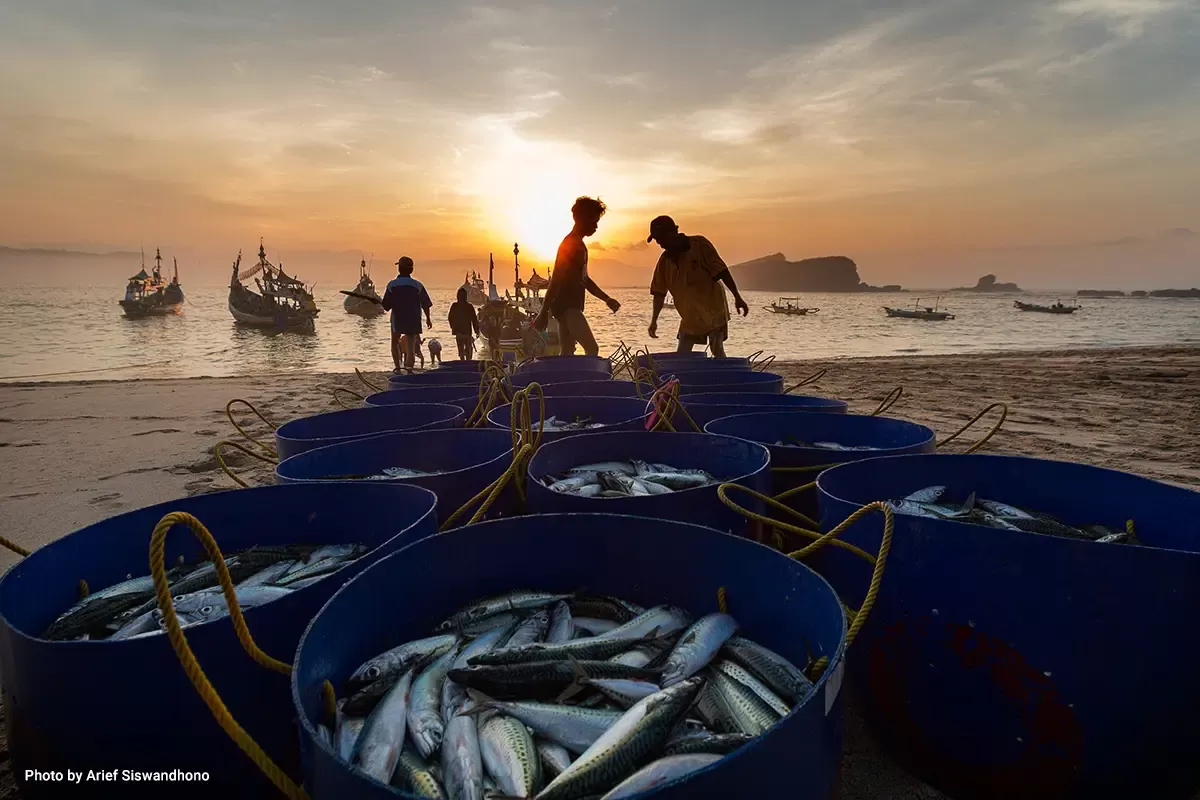
Fish and other aquatic foods are part of everyday diets across the region. They support coastal and inland families, along with the traders, processors, transport workers, market vendors, and small food businesses that depend on a steady catch. When fisheries are poorly managed or illegally exploited, the damage does not stay at sea.
They reach the household plate.
Why IUU fishing matters to ordinary families
Illegal, unreported, and unregulated (IUU) fishing weakens the systems that protect fish stocks. The harm from illegal fishing is not always obvious at first. A catch may be landed, sold, and eaten without anyone seeing the larger loss behind it. But when fish are caught outside the rules, the real condition of the water becomes harder to read. It becomes less clear which species are declining, which areas need time to recover, and how much fishing the sea can still bear.
Over time, that uncertainty shows up in ordinary lives. Small-scale fishers may have to travel farther, spend more on fuel, and stay out longer for a smaller catch. Coastal households may earn less. When the catch becomes unreliable, the pressure shows up in the market. Prices rise, choices shrink, and small food businesses may struggle to keep the dishes their customers expect.
It also creates resentment among fishers. Those who follow the rules can end up at a disadvantage beside those who do not. When that happens often enough, trust weakens—and it becomes harder to convince communities that sustainable fishing is worth the effort.
Sustainable fisheries need livelihoods, not just laws
Stronger rules and enforcement matter, but they cannot carry the whole solution on their own. Fisheries are livelihood systems. If coastal households face poverty, debt, weak market access, and limited alternatives, illegal fishing can become entangled with survival.
This does not excuse illegal activity. But it does show why solutions must be broader than patrols and penalties.
Southeast Asia needs fisheries governance that combines enforcement with community participation, traceability, market incentives, data systems, and livelihood support. Fishers must see that legal and sustainable fishing can also support household income. Young people must see that blue food systems can offer meaningful work in production, processing, logistics, technology, and enterprise.
Aquaculture can help, if it is sustainable
Aquaculture is not a simple replacement for capture fisheries, but it is an important part of the region's food future. When managed well, it can help supply nutritious aquatic foods, create rural livelihoods, and reduce pressure on wild stocks.
For aquaculture to become part of the solution, it must be productive without placing more pressure on the environment. That is not always easy for small-scale producers. Feed can be wasted, water quality can change quickly, labor can be limited, and disease can wipe out gains in a short time.
Through GRAINS, or Grants for Research towards Agricultural Innovative Solutions, SEARCA supports practical research that responds to these kinds of real farm challenges. One example is a smart fish feeder designed for small-scale aquaculture. Using artificial intelligence, computer vision, and Internet of Things sensors, the system helps automate feeding and monitor water quality so farmers can manage their ponds more efficiently. The system is designed to reduce manual labor and feed waste while helping farmers improve efficiency.
This kind of technology is not a solution to IUU fishing by itself. But it is part of the broader answer to Southeast Asia's needs for more sustainable ways to produce aquatic food, support coastal and rural livelihoods, and reduce pressure on marine ecosystems.
Blue food systems need regional cooperation
Fish do not observe political boundaries. Neither do market chains, marine pollution, climate risks, or illegal fishing networks. That is why Southeast Asia needs stronger cooperation across countries, institutions, research organizations, local governments, and fishing communities.
The goal is not only to stop illegal fishing. It is to build aquatic food systems that are legal, sustainable, nutritious, inclusive, and economically viable.
On 5 June, the fight against IUU fishing should be understood as part of a bigger regional agenda: protecting oceans and inland waters, supporting legitimate livelihoods, strengthening food security, and ensuring that the fish on Southeast Asian plates are harvested and produced responsibly.